
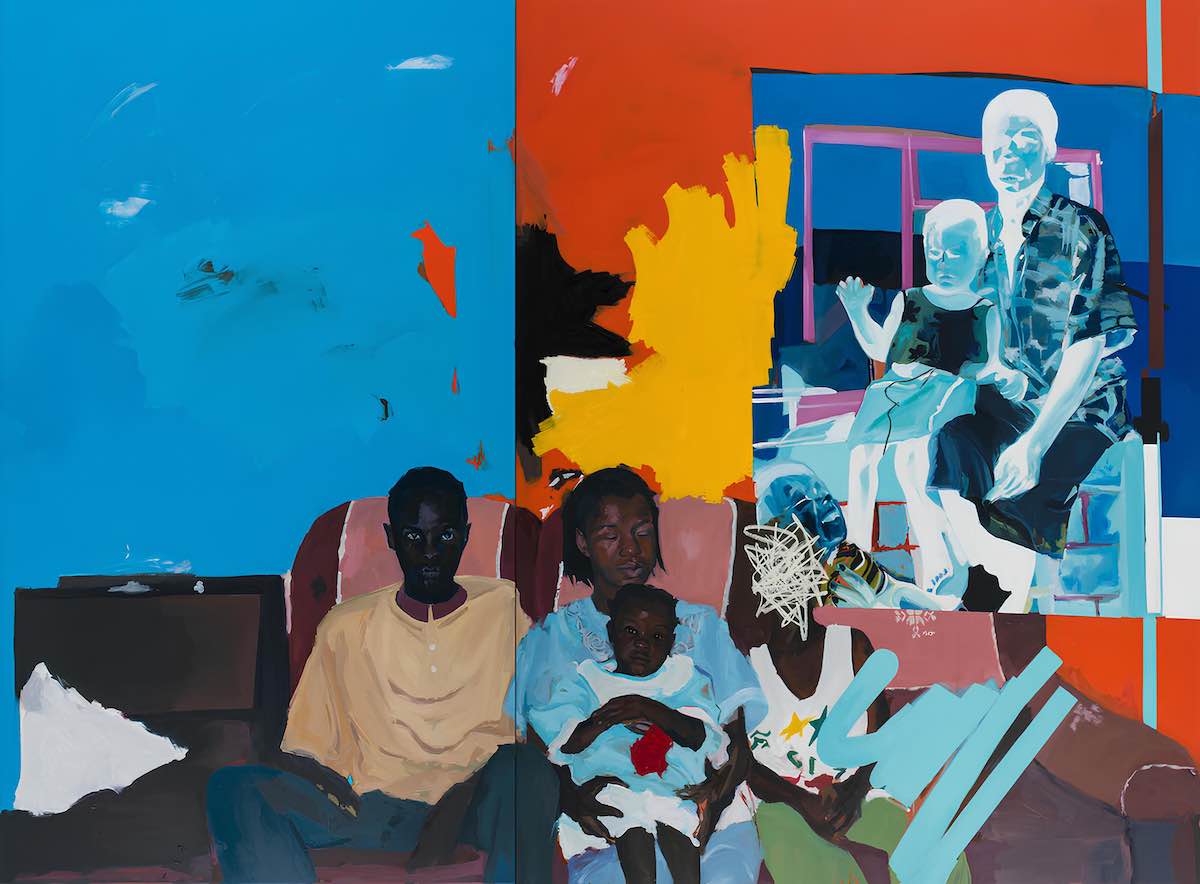
La rappresentazione visiva riesce a svelare il punto di osservazione del singolo artista, quasi i colori e il tratto utilizzati corrispondessero a parole che possono esprimersi solo e unicamente in maniera immediata, corale, attraverso immagini che sintetizzano frasi e concetti; anche l’approccio filosofico all’esistenza, intesa nel senso più o meno ampio a seconda del singolo autore, si trasforma in stile esecutivo personale e distintivo di un’interiorità che ha bisogno di far sentire la propria voce, a volte in maniera più esplicita e quasi gridata, altre più soffusamente, lasciando intendere ciò che l’osservatore deve poi approfondire per comprendere. Kudzanai-Violet Hwami racconta frammenti di vita dell’Africa Meridionale dove lei è nata e vissuta per tutta la sua infanzia, lasciando traccia della sua sensibilità interpretativa ma anche della capacità di andare oltre ciò che è visibile a un primo impatto per cercare il significante che si trova al di sotto della superficie.
Analizzare le radici dell’Arte Africana renderebbe necessario ripercorrere tutto il cammino dell’iconografia tradizionale che tanto aveva ispirato gli artisti europei dei primi decenni del Novecento che diedero vita al fenomeno culturale del Primitivismo; eppure proprio da quel punto in avanti si sono generate connessioni e fusioni tra il mondo artistico europeo e quello africano, grazie da un lato al colonialismo che condusse molte persone benestanti a spostarsi e ad avere possedimenti nel corno d’Africa e nell’Africa del sud, dall’altro alla facilitazione nei viaggi che permisero agli artisti supportati dai mecenati, di viaggiare raggiungendo l’Europa, in quel periodo storico considerata la culla della cultura. Ecco dunque che i movimenti più avanguardisti conquistarono la sensibilità pittorica degli autori africani permettendo loro di mescolare il punto di vista e i paesaggi della loro terra a quelle tecniche in cui ciascuno poteva misurarsi sulla base della predilezione espressiva. Il Cubismo ebbe il suo rappresentante in Ibrahim El-Salahi anche se la sua stilizzazione era estremizzata e più fine di quella del movimento tradizionale, arricchito da forti e distintivi elementi africani che ricordano i tessuti, ma anche con una forte influenza delle linee e delle figure irreali e a volte inquietanti del Surrealismo; a sua volta il Surrealismo Metafisico trovò il suo esponente africano in Chéri Samba, considerato uno dei padri del Modernismo del suo continente, in cui la satira si mescolava a una raffigurazione improbabile, simbolica ma intensamente esplicita.
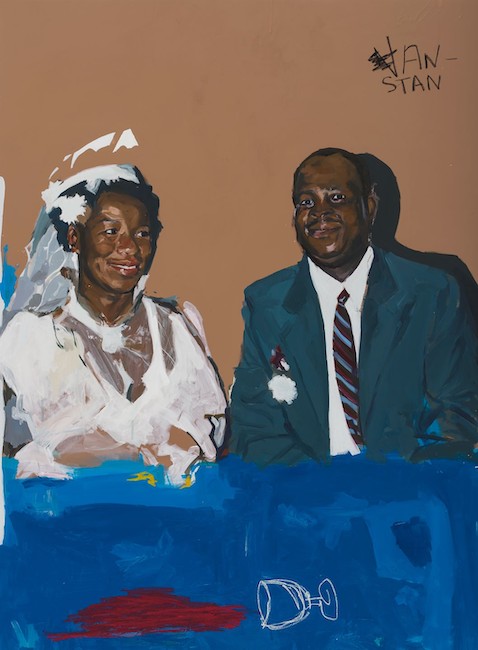
La pittura di Ben Enwonwu invece sembrava costituire un ponte tra le linee guida tipiche del Futurismo, con quella geometricizzazione reiterata per infondere l’idea del movimento, malgrado in lui fosse più attenuato e adeguato ai ritmi lenti o musicali dell’Africa, e quelle dell’Espressionismo funzionale a mettere in luce le tradizioni e gli usi e costumi del suo popolo filtrati con la sua capacità interpretativa. Ernest Mancoba fu forse il primo artista africano ad aderire al rivoluzionario movimento dell’Astrattismo, senza tuttavia mai perdere quei segni e quei simboli legati al suo paese, creando così una forte connessione tra tradizione e assoluta modernità; le sue linee alternavano colori forti e vividi ad altri più tenui, sulla base del concetto e della sensazione che desiderava esprimere. E infine Lippy Lipschitz, che divise la sua produzione tra pittura e scultura, aderì in pieno all’Espressionismo, o forse sarebbe meglio dire alle caratteristiche del Postimpressionismo che contraddistinsero il lavoro di Paul Cézanne, sia per l’utilizzo di un tipo di pittura frastagliata e suddivisa in pennellate lineari e visibili e sia per le forme distorte, mentre la gamma cromatica utilizzata era molto più chiara e impalpabile rispetto a quella del maestro francese. Con il passare degli anni e con l’espandersi delle facilitazioni per approfondire e scoprire le altre culture, l’Arte Africana ha cominciato a far sentire in maniera esponenziale il suo peso a livello internazionale, permettendo ai suoi esponenti di emergere e di farsi notare negli ambienti che contano. Kudzanai-Violet Hwami sceglie di seguire l’impronta espressionista per strutturare il suo stile pittorico, sebbene lasci emergere tutta la modernità esecutiva nell’utilizzo di tecniche miste in cui mescola fotografia e immagini digitali su tela poi arricchite dall’apporto manuale con la pittura a olio, ad acrilico, a pastello, a carboncino, dando così vita a un risultato visivo insolito in cui l’intensità cromatica emerge spesso da sfondi chiari e parzialmente decontestualizzati per introdurre un approfondimento psicologico e sociale dei suoi protagonisti.
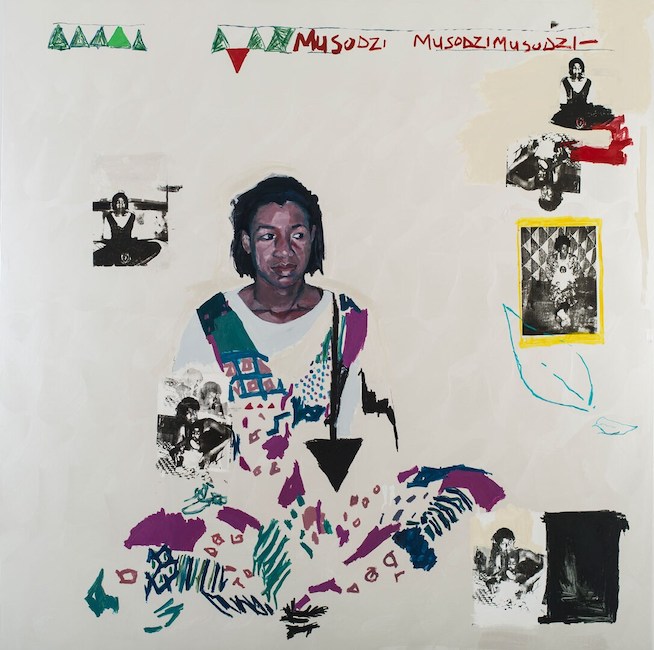
La figurazione costituisce la superficie in virtù della quale Kuzdanai-Violet Hwami esplora le tematiche per lei fondamentali come i legami familiari, l’identità collettiva del suo popolo, quelle abitudini e tradizioni respirate e vissute prima nello Zimbabwe, luogo di nascita, e poi in Sud Africa dove ha vissuto fino all’adolescenza e prima di trasferirsi a Londra.
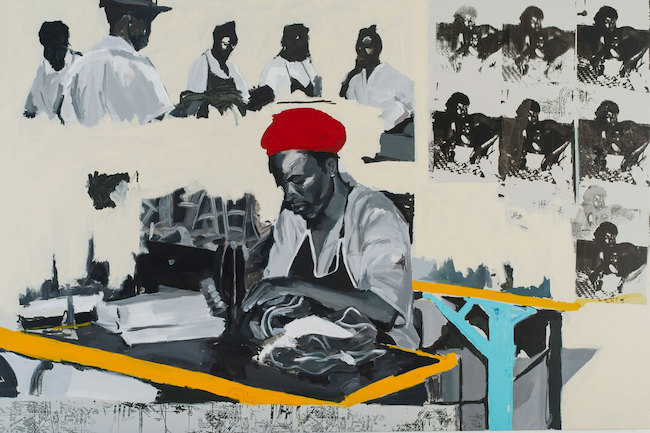
Il sottostrato di questo approfondimento si incunea sulla ricerca del sé, dell’essenza delle proprie radici, di tutti i colori, le voci e le chiacchiere fatte con persone che pur non essendo più parte della sua quotidianità hanno comunque lasciato una traccia profonda nella sua formazione personale. Le opere di Kudzanai-Violet Hwami appaiono come un percorso nostalgico della memoria dei tempi in cui viveva nella sua Africa, gli stralci di episodi e di frammenti di esistenza sembrano fuoriuscire dal tempo e dal ricordo, si delineano in maniera evidente e netta su sfondi neutri e piatti proprio per focalizzare l’attenzione sulla sua gente, che appartenga alla cerchia familiare o a quella più estesa di amici e conoscenti non importa, ciò che conta è sottolineare l’umanesimo che contraddistingue l’osservazione dell’autrice.
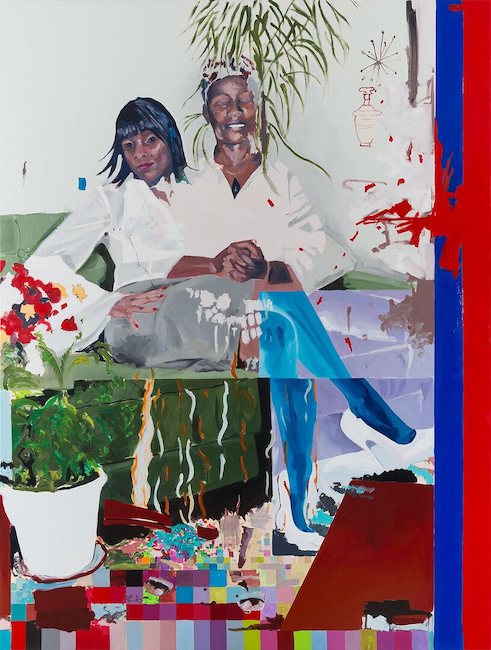
Dunque la figurazione assolutamente espressionista si va a mescolare con un Esistenzialismo junghiano che mette la collettività alla base della formazione inconscia dell’essere umano, ed è per questo che Kudzanai-Violet Hwami non può fare a meno di ripercorrere e di mettere in evidenza i personaggi della sua infanzia e della sua pre-adolescenza, di sottolineare la bellezza di quelle abitudini e di quei ritmi tutti africani che regolano lo scorrere della vita. Nei suoi dipinti affiora la malinconia di un mondo che è stata costretta a lasciare, perché l’Occidente è ancora il posto in cui le generazioni precedenti alla sua dovevano andare per trovare maggiori opportunità e per dare un futuro migliore ai propri figli, pur sapendo di doversi allontanare dal proprio popolo, da un tenore di vita più modesto, certo, ma sicuramente più comunitario, più orientato alla socialità rispetto alle metropoli del nord del mondo.
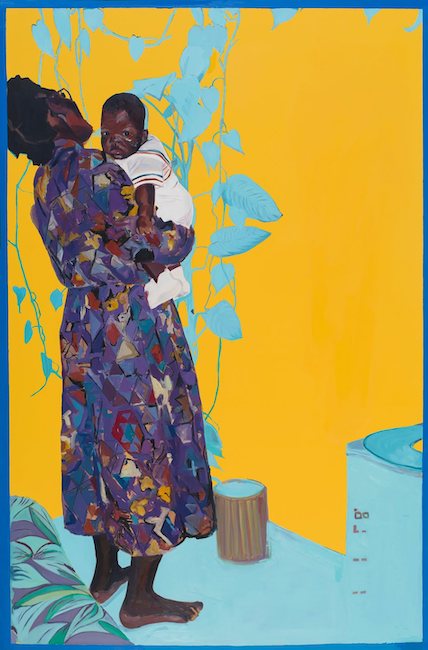
In tutti i lavori, oltre alle immagini principali dei protagonisti, si trovano quasi sempre fotografie, ritratti, stralci di memoria appartenenti al loro passato, o raffiguranti un passaggio importante del loro cammino, perché secondo Kudzanai-Violet Hwami tutto ciò che è stato contribuisce a formare gli strati di consapevolezza della singola personalità, enfatizzando il concetto che solo mantenendo ben saldo il contatto con ciò che si è stati è possibile evolvere senza perdere quelle radici fondamentali che hanno costituito la base essenziale della crescita.
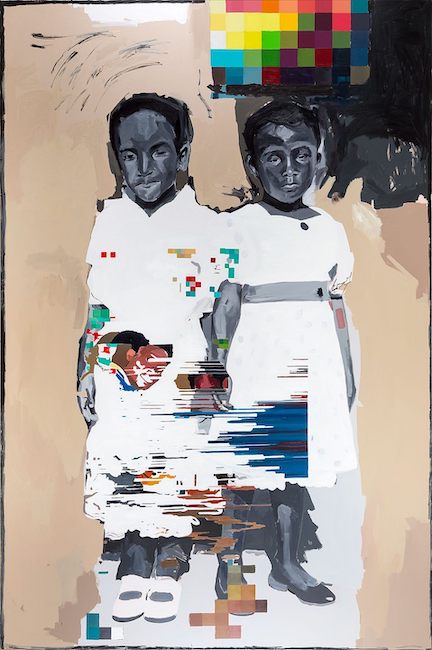
Il dipinto Young Roberta Circa mette al centro della scena due bambini che si tengono per mano e che evidentemente appartengono al passato, questo è il motivo per cui sono descritti in bianco e nero; ma il presente irrompe rigando di colore gli abiti, in maniera quasi simile al tentativo delle televisioni con tubo catodico di molti anni fa di risintonizzarsi dopo aver perso per un po’ il segnale dell’antenna. Tra quelle strisce sembrano nascondersi le evoluzioni compiute da entrambi diverso tempo dopo, impalpabili e indistinguibili eppure emergenti perché laddove il ricordo possa essere molto evidente e preponderante non si può fare a meno di affrontare la realtà e la quotidianità. Lo sfondo è volutamente privo di ogni riferimento perché l’attenzione dell’osservatore, e del ricordo dell’autrice, deve focalizzarsi sui due personaggi.
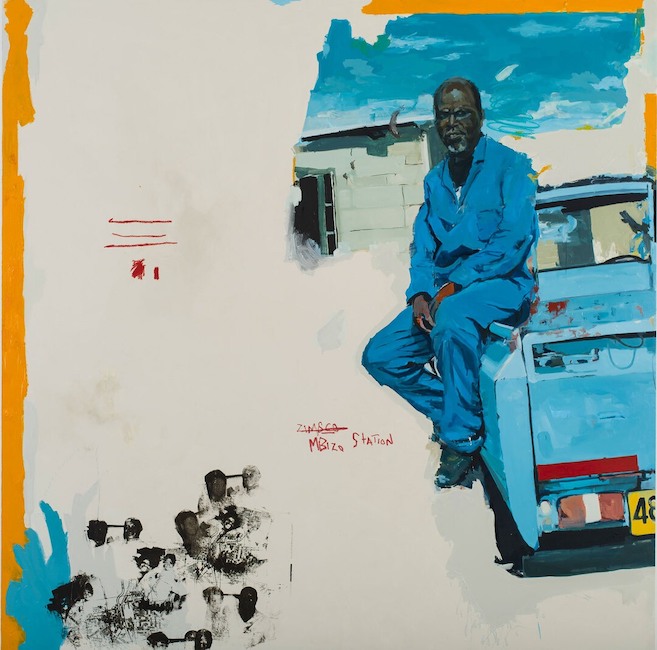
In Mbizo Station Kudzanai-Violet Hwami sembra voler dividere la tela in due parti, quella a colori in cui il protagonista in primo piano siede, come in posa, durante una pausa dal suo lavoro di meccanico, e l’altra in bianco e nero che forse suggerisce i sacrifici compiuti per riuscire ad avere una sua attività, il sudore dei tentativi e anche la delusione dei fallimenti grazie ai quali è riuscito a raggiungere la professionalità che lo contraddistingue oggi. L’uomo è sicuro di sé e dunque l’autrice lo raffigura con i suoi veri colori, quelli intensi appartenenti all’Africa e funzionali all’essere umano a distinguersi e a spiccare dalla distesa terrosa della savana; ma la memoria non può fare a meno di correre verso un passato, per quanto recente, che ha generato la conquista dell’oggi.
Kudzanai-Violet Hwami ha al suo attivo la partecipazione a mostre e fiere d’arte in Francia, Sudafrica, Regno Unito, Martinica e Zimbabwe; nel 2019 ha presentato le sue opere alla 58ª Biennale di Venezia nell’ambito del padiglione dello Zimbabwe
KUZDANAI-VIOLET HWAMI-CONTATTI
Email: info@victoria-miro.com
Sito web: www.victoria-miro.com/artists/240-kudzanai-violet-hwami/
Instagram: www.instagram.com/mwana.wevhu/
The personal journey of Kudzanai-Violet Hwami’s Existentialist Expressionism, between collective identity and the search for the self
Visual representation succeeds in revealing the individual artist’s point of view, as if the colors and brushstrokes used were words that can be expressed only and exclusively in an immediate, collective manner, through images that encapsulate phrases and concepts; even the philosophical approach to existence, intended in a sense that varies in breadth depending on the individual artist, transforms into a personal and distinctive artistic style that reflects an inner world in need of making its voice heard, sometimes more explicitly and almost shouted, other times more subtly, hinting at what the viewer must then explore further to understand. Kudzanai-Violet Hwami depicts fragments of life in Southern Africa, where she was born and spent her entire childhood, leaving a trace of her interpretive sensibility but also of her ability to go beyond what is visible at first glance to seek the meaning that lies beneath the surface.
Analyzing the roots of African Art would require retracing the entire history of traditional iconography, which so greatly inspired the European artists of the early decades of the twentieth century who gave rise to the cultural phenomenon of Primitivism; and yet, it was precisely from that point onward that began to emerge connections and fusions between the European and African artistic worlds, thanks on the one hand to colonialism which led many wealthy people to relocate and acquire estates in the Horn of Africa and Southern Africa, and on the other hand to the ease of travel that allowed artists, supported by patrons, to journey to Europe that in that historical period was considered the cradle of culture. Thus, the most avant-garde movements influenced the painterly sensibilities of African artists, enabling them to blend the perspectives and landscapes of their homeland with those techniques, which each artist could explore according to their own expressive preferences. Cubism found its representative in Ibrahim El-Salahi, although his stylization was more extreme and refined than that of the traditional movement, enriched by strong and distinctive African elements reminiscent of textiles, yet also strongly influenced by the unreal and at times unsettling lines and figures of Surrealism; Metaphysical Surrealism, in turn, found its African exponent in Chéri Samba, considered one of the fathers of Modernism on his continent, in whose work satire blended with improbable, symbolic yet intensely explicit depictions. Ben Enwonwu’s painting, on the other hand, seemed to bridge the typical guiding principles of Futurism, with its repeated geometricization intended to convey the idea of movement, although in his work this was more subdued and adapted to the slow, musical rhythms of Africa, and those of Expressionism which served to highlight the traditions, customs, and practices of his people, filtered through his interpretive lens. Ernest Mancoba was perhaps the first African artist to embrace the revolutionary Abstract Art movement, yet without ever losing the signs and symbols tied to his homeland, thereby creating a strong connection between tradition and absolute modernity; his lines alternated between strong, vivid colors and softer ones, depending on the concept and feeling he wished to express.
And finally, Lippy Lipschitz, who divided his work between painting and sculpture, fully embraced Expressionism, or perhaps it would be better to say to the characteristics of Post-Impressionism that distinguished the work of Paul Cézanne, both in his use of a jagged style of painting divided into linear, visible brushstrokes and in his distorted forms, while the color palette he employed was much lighter and more ethereal than that of the French master. As the years have passed and opportunities to explore and discover other cultures have expanded, African art has begun to make an exponentially greater impact on the international stage, allowing its artists to emerge and gain recognition in influential circles. Kudzanai-Violet Hwami chooses to follow an expressionist approach in shaping her painterly style, though she fully embraces modern techniques through the use of mixed media, blending photography and digital images on canvas, which she then enriches with hand-applied oil, acrylic, pastel, and charcoal, thus creating an unusual visual effect in which chromatic intensity often emerges from light, partially decontextualized backgrounds to introduce a psychological and social exploration of her subjects. Figurative art serves as the medium through which Kuzdanai-Violet Hwami explores themes that are fundamental to her, such as family ties, the collective identity of her people, and the customs and traditions she absorbed and lived out first in Zimbabwe, her birthplace, and then in South Africa, where she lived until her teenage years before moving to London.
The underlying theme of this exploration centers on the search for the self, for the essence of her roots, and for all the colors, voices, and conversations shared with people who, though no longer part of her daily life, have nonetheless left a profound mark on her personal development. Kudzanai-Violet Hwami’s works appear as a nostalgic journey through memories of the times when she lived in her native Africa; excerpts of episodes and fragments of existence seem to emerge from time and memory, standing out clearly and sharply against neutral, flat backgrounds precisely to focus attention on her people, whether they belong to her immediate family or to the wider circle of friends and acquaintances matters not, what counts is emphasizing the humanism that characterizes the artist’s perspective. Thus, the thoroughly expressionist style blends with a Jungian Existentialism that places the collective at the foundation of the human being’s unconscious formation, and this is why Kudzanai-Violet Hwami cannot help but revisit and highlight the figures from her childhood and pre-adolescence, putting in evidence the beauty of those distinctly African customs and rhythms that govern the flow of life. In all her paintings comes to the surface the melancholy of a world she was forced to leave behind because the West is still the place where previous generations had to go to find greater opportunities and to give their children a better future, even while knowing they would have to leave behind their own people and a standard of living that was certainly more modest but also more community-oriented and more focused on social interaction than the metropolises of the Northern hemisphere.
In all her works, in addition to the main images of the protagonists, there are almost always photographs, portraits, snippets of memory from their past, or depicting an important milestone in their journey, because, according to Kudzanai-Violet Hwami, everything that has been contributes to forming the layers of consciousness of the individual personality, emphasizing the concept that only by maintaining a firm connection with who one once was is it possible to evolve without losing those fundamental roots that have formed the essential foundation of one’s growth. The painting Young Roberta Circa places two children holding hands at the center of the scene, they clearly belong to the past, which is why they are depicted in black and white; but the present bursts in, streaking the clothes with color, much like the way cathode-ray tube televisions from years ago would try to retune after briefly losing the antenna signal. Hidden among those stripes seem to be the changes both have undergone some time later, intangible and indistinguishable, yet emerging, because even where memory may be very evident and dominant, one cannot help but confront reality and everyday life. The background is deliberately devoid of any reference points because the viewer’s attention, and the artist’s memory, must focus on the two figures.
In Mbizo Station, Kudzanai-Violet Hwami seems to want to divide the canvas into two parts, the colored section where the protagonist sits in the foreground, as if posing, during a break from his work as a mechanic, and the black-and-white section that perhaps suggests the sacrifices he made to establish his own business, the sweat of his efforts and even the disappointment of his failures, all of which enabled him to achieve the professionalism that sets him apart today. The man is self-assured, and so the artist depicts him in his true colors, those intense hues native to Africa that help humans distinguish themselves and stand out against the earthy expanse of the savanna; yet his memory cannot help but drift toward a past, however recent, that paved the way for today’s achievements. Kudzanai-Violet Hwami has participated in art exhibitions and fairs in France, South Africa, the United Kingdom, Martinique, and Zimbabwe; in 2019, she presented her works at the 58th Venice Biennale as part of the Zimbabwe Pavilion.