
Esiste un modo di osservare la realtà che può uscire dagli schemi abituali e che trova nella mancanza di luce la dimensione perfetta per approfondire e infondere nell’osservatore la sensazione di suggestione enigmatica che l’autore intende imprimere alle sue tele; perché spesso è proprio attraverso il buio che l’animo riesce a mettersi in contatto con se stesso e a osservare quei dettagli che con la luminosità del giorno non riuscirebbero a emergere, ed è esattamente in virtù di un’ambientazione lunare che alcuni artisti riescono a sussurrare ciò che diversamente resterebbe inascoltato. Nel caso del protagonista di oggi, laddove la luce può essere messa in secondo piano, non può tuttavia mancare il riferimento visivo, quel prendere spunto dalla realtà osservata che poi viene trasformata sulla base del suo sentire, del suo lasciare riferimenti su cui il fruitore è chiamato a riflettere e a perdersi, quasi si trovasse all’interno di un mondo fiabesco e silenzioso che stimola l’esigenza di scoprirne i segreti più nascosti.
Dopo i vivaci e dinamici, dal punto di vista delle avanguardie artistiche, primi decenni del Novecento, si delineò in Italia e in Europa l’esigenza di un recupero di tutto ciò che l’Arte Astratta, il Cubismo e il Futurismo avevano allontanato e rinnegato; l’eccessiva geometricizzazione e reiterazione delle figure protagoniste aveva infatti portato sia i cubisti che i futuristi ad avvicinarsi quasi completamente all’irriconoscibilità del reale riconducibile alle tematiche dell’Astrattismo, provocando in un numeroso gruppo di artisti un senso di ribellione e di desiderio di recuperare le linee più classiche e realiste. Capostipite di questa esigenza fu in Italia il Gruppo Novecento i cui maggiori rappresentanti, Mario Sironi e Anselmo Bucci, recuperarono la figurazione mantenendo tuttavia un ordine compositivo che conservò la geometricità cubista sebbene epurata da tutti gli eccessi delle opere di Pablo Picasso e Georges Braque. Ma l’esigenza del Ritorno all’ordine precedente alla rivoluzione astrattista, si manifestò anche in altri movimenti dello stesso periodo che adeguarono il concetto di recupero di una figuratività più realista a un approccio differente, meno oggettivo e più orientato al Classicismo, nel caso della Metafisica di Giorgio de Chirico, oppure più legato alle energie sottili e misteriose che divennero le linee guida principali del Realismo Magico. Dunque, anche se diversi nella rappresentazione formale, questi movimenti andarono in controtendenza rispetto alle innovazioni precedenti, sottolineando la necessità dell’arte di mantenere anche un contatto con la realtà osservata, malgrado quest’ultima fosse ammantata di un soggettivismo che non aveva fatto parte di nessuna delle correnti del passato.
Il recupero della tradizione non si fermò ai confini nazionali bensì trovò una solida sponda anche in Germania, dove la Nuova Oggettività, in qualche modo collegabile al Realismo Magico malgrado il suo approccio più crudo e analitico della realtà che si distaccava dunque dal senso di straniamento tipico della corrente italiana, si propose di recuperare quel messaggio diretto e immediato che solo la figurazione poteva infondere. E ancora, dall’altra parte dell’oceano, sempre dopo il caos generato dalla prima guerra mondiale, nacque il Precisionismo che mantenne le atmosfere cupe delle opere di Mario Sironi, ma si soffermò su una celebrazione della modernizzazione dei paesaggi urbani statunitensi che vide la nascita di fabbriche e di cantieri portuali e industriali resi, nelle tele di Georgia O’Keeffe e Charles Demuth tra gli altri, con la presenza di ciminiere e di edifici rappresentati con uno stile in cui il Realismo si mescolava al rigore geometrico del Cubismo, pur perdendo anche in questo caso l’estremo più dissolutivo dell’immagine. L’artista sardo Giovanni Atzeni, grafico pubblicitario prima e insegnante di educazione artistica poi, si colloca esattamente in questo contesto espressivo dal punto di vista stilistico, poiché le sue opere mostrano un approccio riflessivo, meditativo e al contempo oggettivo sulla realtà osservata che deve essere raccontata nella sua forma più facilmente ricevibile dallo sguardo; ma è esattamente quando l’occhio viene condotto verso le atmosfere lunari delle sue tele, che scopre un punto di vista diverso, quello di un enigma affiorante contestualmente a una figurazione immediata, spontanea, fanciullesca che non può non attingere all’ingenuità Naïf che era stata capace di inventare e riprodurre scene generate dalla pura fantasia.
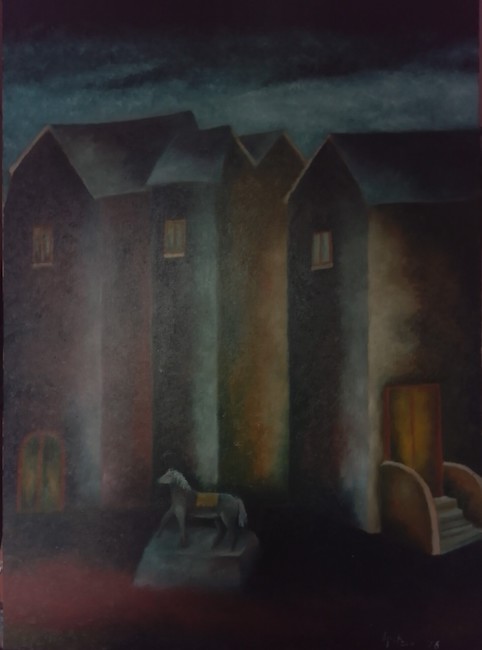
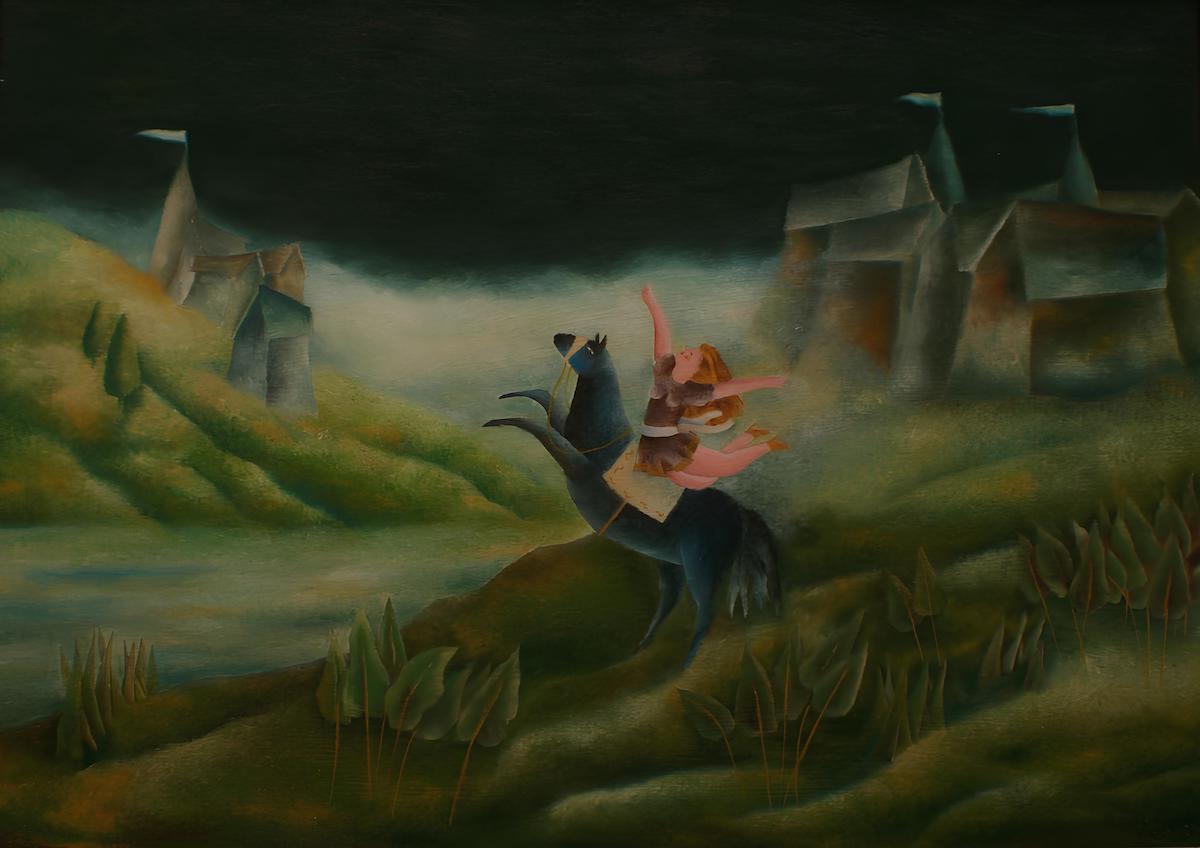
I personaggi di Giovanni Atzeni sembrano infatti uscire da un libro di favole, mostrano l’immediatezza di atteggiamenti puri e genuini; nella composizione e nella rappresentazione degli edifici quasi irrinunciabili nelle sue opere, come se i muri e i tetti contribuissero a infondere quel senso di familiarità e di intimità attraverso cui sussurra all’osservatore, emerge la rigorosità del Cubismo attraverso la quale definisce e scolpisce quei tetti, quei muri, quelle piazze tanto appartenenti al suo immaginario artistico.
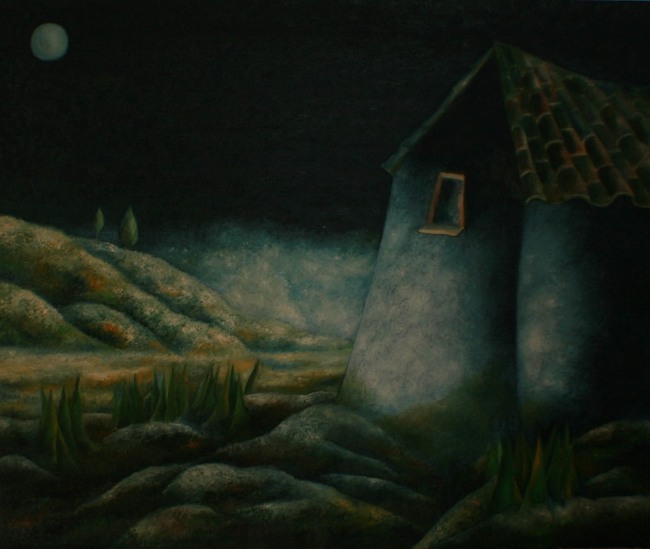
Scegliendo atmosfere notturne o nuvolose, l’autore si orienta verso una tavolozza cromatica in cui a prevalere sono le tonalità scure, il lato meno luminoso dei colori che tuttavia mostrano una loro vitalità intrinseca che si rivela in virtù delle sfumature impalpabili che avvolgono i soggetti, siano essi animati o inanimati; questo approccio tonale riconduce all’Arte Fiamminga del Quattrocento e sottolinea quanto lo stile pittorico di Giovanni Atzeni sia singolare e personalizzato perché frutto di una mescolanza di radici riattualizzate secondo la poetica espressiva dell’autore. Non solo, a emergere osservando i paesaggi malinconici, è anche l’enigma sottile, quel mistero silenzioso appartenente, dal punto di vista panoramico, alle ambientazioni della Metafisica di Giorgio De Chirico, mentre nella narrazione umana la vicinanza è allo straniamento disorientato, e disorientante, tipico del Realismo Magico.
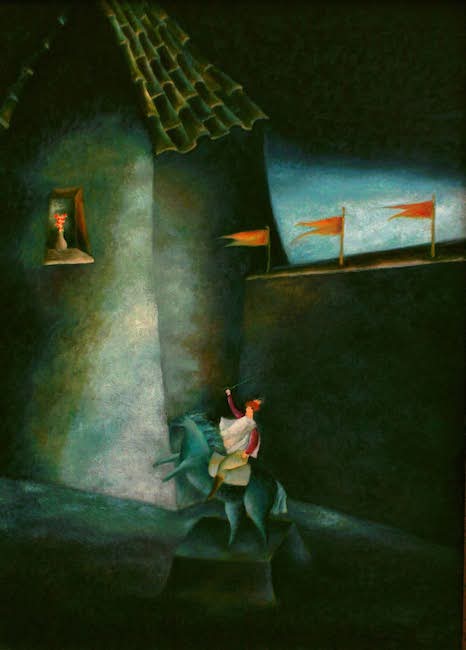
Piazza con statua equestre ha una struttura estremamente ordinata, rigorosa nella disposizione dell’edificio e del muretto che sovrastano la scultura in basso, poi però il tetto sembra sovvertire l’idea e il riferimento alla Metafisica per tendere verso una morbidezza ondulata che permette di entrare nel reame della fiaba. L’atmosfera, al contrario, sottintende una suggestione silenziosa, come se in quel panorama privo di presenza umana aleggiasse l’eco di un passaggio appena avvenuto, di una persona alla finestra appena ritiratasi nel calore della casa lasciando visibile il solo vaso di fiori. Qui la notte non è ancora completamente scesa e il chiarore del cielo dietro al muretto rende i colori della statua ancora vividi prima che il manto scuro cali attenuandone le tonalità.
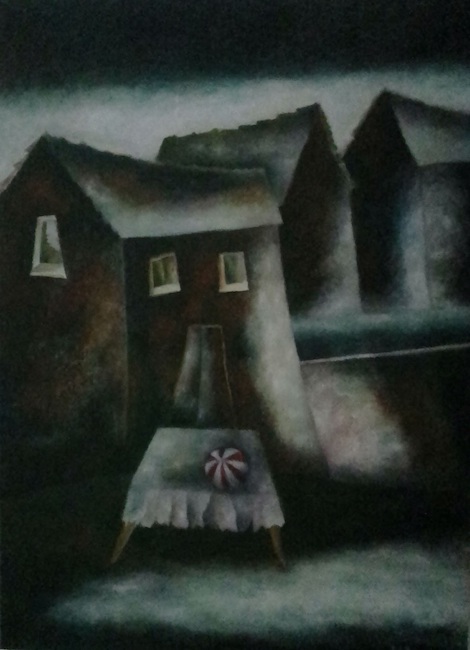
Senza titolo presenta invece un’atmosfera differente, la sensazione è di attesa, di sospensione del tempo dopo, chissà, un avvenimento condiviso dai membri di quella piccola comunità di quartiere la cui scia si evidenza con la presenza di una tavola apparecchiata dove sono state accolte sedie, risate, grida di bambini, eco di un trascorso che non fa parte del momento presente. Le case e la strada sono contornate da una luce soffusa, quella dei lampioni che di notte si accendono per rendere meno cupo il buio. Anche in questo dipinto a emergere è l’attitudine all’ordine quasi geometrico di Giovanni Atzeni accompagnato però da una morbidezza emozionale che attenua gli spigoli, gli angoli e persino i fasci di luce che pertanto si diffondono come fossero ovattati, osservati con una lente da presbiti quando non lo si è e dunque tutto si ammanta di atmosfera emozionale più che di enigma metafisico.
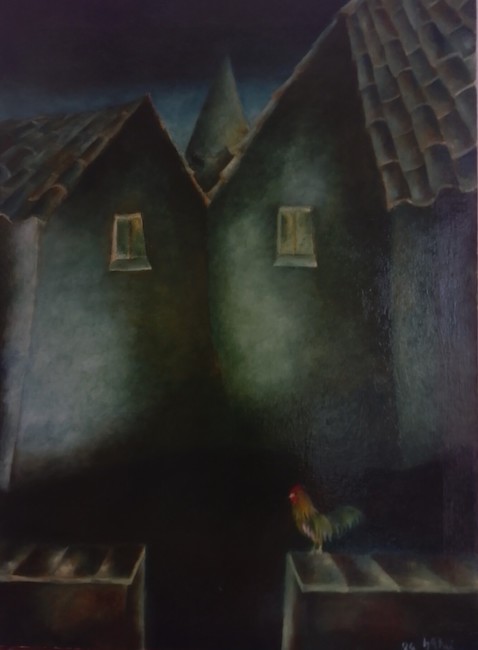
Nella tela Il gallo nel cortile però, Giovanni Atzeni si sposta nel mondo più favolistico in virtù del quale dona un’anima, una personalità a quelle due case che sembrano guardarsi l’una con l’altra, quasi a volersi stringere la mano come una coppia di innamorati, e che vegliano insieme sul gallo sottostante in attesa del chiarore dell’alba per poter cantare e dare inizio a un nuovo giorno. L’animale si trova su un muretto e rappresenta quell’invito al risveglio che si genera anche dopo la notte più buia, anche dove tutto è inanimato e sembra volgere al suo termine definitivo; in qualche modo sembra di sentire la voce narrante dell’autore che suggerisce una storia enigmatica e misteriosa legata all’immagine che ha dipinto, dando così un’accezione fortemente lirica alla composizione.
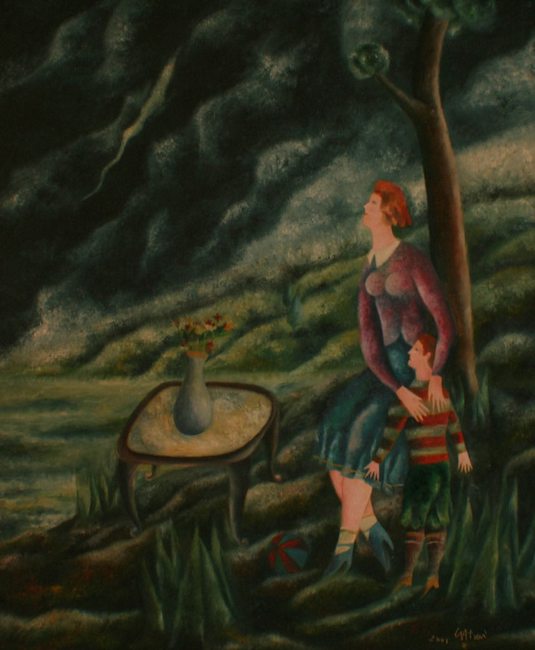
Il fulmine è la tela in cui Giovanni Atzeni si distacca dalla rappresentazione urbana perdendosi invece nella natura in cui posiziona una mamma con il suo bambino durante un pic-nic, spaventati dall’imminente arrivo della pioggia; oltre al cielo cupo e al fulmine che squarcia i nembi scuri, è l’atteggiamento protettivo della donna che, pur non avendo un ombrello né un posto vicino dove ripararsi, si preoccupa solo di far sentire al sicuro suo figlio, enfatizzando dunque l’attenzione alle piccole cose e alla spontaneità fanciullesca che contraddistingue tutta la produzione artistica dell’autore.
Giovanni Atzeni nel suo lungo percorso artistico ha partecipato a mostre collettive e personali a Cagliari, Torino, Grosseto, Imperia, al Centro Giovanni Lilliu di Barumini e allo Studio C di Piacenza, ed è stato inserito in importanti pubblicazioni tra cui l’Atlante dell’Arte Contemporanea Giunti MoMa Edition 2026.
GIOVANNI ATZENI-CONTATTI
Email: giovannitzn51@gmail.com
Facebook: www.facebook.com/profile.php?id=100018015585839
Giovanni Atzeni’s nocturnal atmospheres, where fairy tales blend with Magical Realism and reach out toward Metaphysical Art
There is a way of observing reality that can break free from conventional patterns and finds in the absence of light the perfect setting to delve deeper and instill in the viewer the sense of enigmatic allure that the artist intends to imprint on his canvases; because it is often precisely through the darkness that the soul manages to connect with itself and observe details that would not emerge in the light of day, indeed it is thanks to a moonlit setting that some artists are able to whisper what would otherwise remain unheard. In the case of today’s protagonist, while light may take a back seat, there is an essential need for a visual reference, a starting point drawn from observed reality that is subsequently transformed through the artist’s own feeling, of his leaving references for the observer to reflect upon and lose himself in as if they were inside a silent, fairytale world that stirs a desire to uncover its most hidden secrets.
After the lively and dynamic early decades of the 20th century, from the perspective of the artistic avant-garde, a need emerged in Italy and Europe to reclaim everything that Abstract Art, Cubism, and Futurism had set aside and rejected; the excessive geometrization and repetition of central figures had, in fact, led both the Cubists and the Futurists to approach a state where reality was almost completely unrecognizable, a trend linked to the themes of Abstract Art, thereby provoking a sense of rebellion among a large group of artists and a desire to return to more classical and realistic lines. The forerunner of this movement in Italy was the Gruppo Novecento, whose leading figures, Mario Sironi and Anselmo Bucci, revived figurative art while maintaining a compositional order that retained Cubist geometry, albeit stripped of all the excesses found in the works of Pablo Picasso and Georges Braque. But the desire to return to the order that preceded the abstract revolution also manifested itself in other movements of the same period, which adapted the concept of reviving a more realistic figurative style to a different approach, less objective and more oriented toward Classicism, in the case of Giorgio de Chirico’s Metaphysical Art, or more closely linked to the subtle and mysterious energies that became the main guiding principles of Magical Realism. Thus, although they differed in their formal representation, these movements went against the trend of previous innovations, underling the need for art to maintain a connection with observed reality, even though that reality was cloaked in a subjectivism that had not been part of any of the past movements. The revival of tradition did not stop at national borders but found solid support also in Germany wthere the New Objectivity, in some ways linkable to Magical Realism despite an approach to reality that was cruder and more analytical that diverged from the sense of estrangement typical of the Italian movement, sought to reclaim the direct, immediate message that only figurative art could convey. Meanwhile on the other side of the Atlantic, also in the wake of the chaos wrought by World War I, emerged Precisionism that retained the somber atmosphere found in the artworks of Mario Sironi, but focused on celebrating the modernization of American urban landscapes that saw the rise of factories and industrial dockyards depicted in the canvases of artists such as Georgia O’Keeffe and Charles Demuth through smokestacks and buildings rendered in a style that blended Realism with the geometric rigor of Cubism, yet without adopting the latter’s tendency toward extreme image fragmentation.
The Sardinian artist Giovanni Atzeni, first a graphic designer and later an art teacher, fits perfectly into this expressive context from a stylistic standpoint, as his works reveal a reflective, meditative, and at the same time objective approach to observed reality, which must be portrayed in a form most readily accessible to the eye; but it is exately when the eye is drawn toward the lunar atmospheres of his canvases that it discovers a different perspective, the one of an enigma emerging alongside an immediate, spontaneous, childlike figuration that cannot help but draw on the Naïve innocence capable of inventing and reproducing scenes born of pure imagination. Giovanni Atzeni’s characters, in fact, seem to step out of a fairy tale book, displaying the immediacy of pure and genuine gestures; in the composition and depiction of the buildings, almost indispensable in his paintings as if the walls and roofs helped instill that sense of familiarity and intimacy through which he whispers to the viewer, emerges the rigor of Cubism through which he defines and sculpts those roofs, those walls, and those squares so integral to his artistic imagination. By choosing nocturnal or cloudy atmospheres, the artist turns to a color palette dominated by dark tones, the less luminous side of colors, which nonetheless reveal their own intrinsic vitality through the subtle nuances that envelop the subjects, whether animate or inanimate; this tonal approach harks back to 15th-century Flemish Art and underscores just how unique and personal Giovanni Atzeni’s painterly style is, as it is the result of a blend of roots reinterpreted according to the artist’s expressive poetics. Moreover, observing these melancholic landscapes reveals a subtle enigma, a silent mystery that, from a panoramic point of view it evokes the settings of Giorgio de Chirico’s Metaphysical art, while on the level of human narrative, it approaches the disoriented, and disorienting, sense of estrangement typical of Magical Realism. Piazza con statua equestre (Square with an equestrian statue) has an extremely orderly structure with a rigorous arrangement of the building and the low wall that tower over the sculpture below, yet the roof seems to subvert this idea and the reference to Metaphysical Art, tending instead toward a soft, undulating quality that allows one to enter the realm of fairy tales.
The atmosphere, on the contrary, conveys a quiet sense of suggestion, as if the echo of a moment just past were lingering in that scene devoid of human presence, of a person at the window who has just retreated into the warmth of the house, leaving only the vase of flowers in view. Here the night has not yet fully fallen and the glow of the sky behind the low wall keeps the statue’s colors vivid before the dark veil descends, softening their hues. Senza titolo (Untitled ) presents instead a different atmosphere, the sensation is that of anticipation, of time standing still after, who knows, an event shared by the members of that small neighborhood community, the traces of which are evident in the presence of a set table where chairs, laughter, and children’s shouts once gathered, echoes of a past that is no longer part of the present moment. The houses and the street are bathed in a soft light, that of the streetlamps that come on at night to make the darkness less gloomy. In this painting too emerges Giovanni Atzeni’s penchant for an almost geometric order accompanied, however, by an emotional softness that smooths out sharp edges, angles, and even the beams of light which diffuse as if they were muffled, observed through a reading lens worn by someone who does not need them, thereby enveloping everything in an emotional atmosphere rather than a metaphysical enigma. In the painting Il gallo nel cortile (The Rooster in the Courtyard), however, Giovanni Atzeni moves into a more fairy-tale-like world through which he imbues those two houses, that seem to gaze at one another almost as if wanting to shake hands like a couple in love, with a soul and a personality, and watching together over the rooster below, who is awaiting the first light of dawn so to crow and starting a new day.
The rooster perches on a low wall and symbolizes that call to awaken that emerges even after the darkest night, even where everything is lifeless and seems to be drawing to its final end; in some way, one seems to hear the artist’s narrative voice suggesting an enigmatic and mysterious story tied to the image he has painted, thus lending the composition a deeply lyrical quality. Il fulmine (The lightning) is the canvas through which Giovanni Atzeni breaks away from urban depictions immersing himself instead in nature, where he places a mother and her child during a picnic, frightened by the imminent arrival of rain; in addition to the gloomy sky and the lightning that splits the dark clouds, to stand out it is the protective gesture of the woman who, even though not having an umbrella nor a nearby place to take shelter, her sole concern is to make her son feel safe, thus emphasizing the attention to small details and childlike spontaneity that characterizes the artist’s entire body of work. Throughout his long artistic career, Giovanni Atzeni has participated in group and solo exhibitions in Cagliari, Turin, Grosseto, Imperia, at the Giovanni Lilliu Center in Barumini, and at Studio C in Piacenza, and has been featured in major publications including the Atlante dell’Arte Contemporanea Giunti MoMa Edition, 2026.