
Talvolta l’arte si trasforma in possibilità di rivelare un’interiorità divisa tra l’esigenza di lasciarsi andare alla parte più emotiva di sé, e l’abitudine a mantenere il forte legame con quella più razionale, riflessiva, meditativa; dunque l’espressione creativa è una terra di mezzo in cui far convivere in perfetto equilibrio queste due differenti e solo apparentemente opposte anime, trovando uno stile affine a un dualismo irrinunciabile per questo tipo di interpreti. La figurazione pertanto perde il legame con la realtà per trascendere il visibile trasformandolo in emanazione di un approccio osservativo che va all’essenza, al nocciolo, di tutto ciò che viene colto dallo sguardo, poiché il rimbalzo inevitabile tra mente e istinto è funzionale a generare un linguaggio inedito e affascinante quanto spontaneo per chi si trova davanti a questo genere di opere. Juri Perin appartiene esattamente a questa categoria di artisti per i quali dipingere equivale a rivelare il dualismo della sua natura interiore e, di conseguenza, espressiva.
Gli inizi del Ventesimo secolo portarono con sé, dal punto di vista artistico, scoperte e sperimentazioni avvenute nella seconda metà dell’Ottocento e che potevano essere la base di nuove ricerche più audaci, più al passo con i cambiamenti epocali che una società in forte accelerazione in tutti gli ambiti stava genenerando. Tra le intuizioni più radicali degli anni precedenti vi fu quella compiuta dagli impressionisti poiché la frammentazione della pennellata per costruire un’immagine aderente alla realtà solo attraverso l’accostamento di colori, non più ottenuti mescolandoli sulla tavolozza e poi sovrapponendoli sulla tela bensì poggiati in maniera pura inducendo l’osservatore ad allontanarsi da essa per vederne la resa finale, indusse i protagonisti degli inizi del nuovo secolo ad approfondire proprio il tema della frammentazione. Il Futurismo e il Cubismo furono le due avanguardie che ruppero ogni legame con l’estetica tradizionale, ancora centrale negli interpreti dell’Impressionismo, per enfatizzare ed esasperare proprio quella scomposizione ampliandola a tutta la figura, dunque non solo al colore e alla sua resa, trasformando la visione che ne derivava. Pablo Picasso e Georges Braque da un lato, Filippo Tommaso Marinetti e Umberto Boccioni dall’altro, mostrarono quanto la decostruzione potesse coniugare un’analisi scientifica e logica a un sentire interiore che inevitabilmente fuoriusciva dalle loro tele, malgrado le intenzioni dei due movimenti tendessero a mettere in secondo piano proprio il mondo emotivo. Anche il Surrealismo, che mantenne una figurazione tradizionale pur spingendola verso il mondo dell’assurdo, dell’insolito, dell’inquietante e del destabilizzante, scompose a suo modo le ambientazioni reali per introdurvi personaggi antropomorfi, atmosfere postapocalittiche, mostri della mente e, nell’accezione più Metafisica del movimento, quella riconducibile al belga René Magritte, ai giochi visivi in cui a emergere erano gli enigmi e le stranezze che ironicamente venivano messe in luce attraverso le sue opere.
Anche nel caso del Surrealismo, anche qui a dispetto del desiderio degli artisti aderenti a mettere in secondo piano la sfera emotiva contrapponendosi pertanto all’Espressionismo dove invece a essere predominante in maniera assoluta era proprio la soggettività, in molte tele è impossibile non notare il pensiero, il sentire dell’autore, sia nel caso del più mentale Magritte, sia in quello dei più inquietanti Dalì e Ernst perché in tutti loro a emergere era il mondo onirico che non poteva non legarsi all’istinto e all’irrazionalità. Nonostante la distanza che i movimenti volevano mantenere gli uni dagli altri, vi furono autori che conciliarono le differenze dando vita a un linguaggio espressivo unico e avvolgente, come Giorgio Morandi per cui la rigorosità geometrica delle figure veniva ammorbidita da una riflessione Metafisica, e anche emozionale, sul valore intrinseco di tutto ciò che appartiene alla quotidianità divenendo conferma e certezza irrinunciabile. L’artista milanese Juri Perin a sua volta coniuga nel suo stile non solo le due estremità espressive, quella più analitica e razionale e quella che non può fare a meno di porsi in ascolto della magia intorno a sé, con quella semplicità che induce la sua interiorità ad aprirsi e ad avvolgere le tele di quel sentire spontaneo e intuitivo con il quale osserva tutto ciò che accade intorno, ma fonde anche le caratteristiche di due dei movimenti citati in precedenza, il Cubismo e il Surrealismo, dando vita a uno stile definibile come Cubettismo.
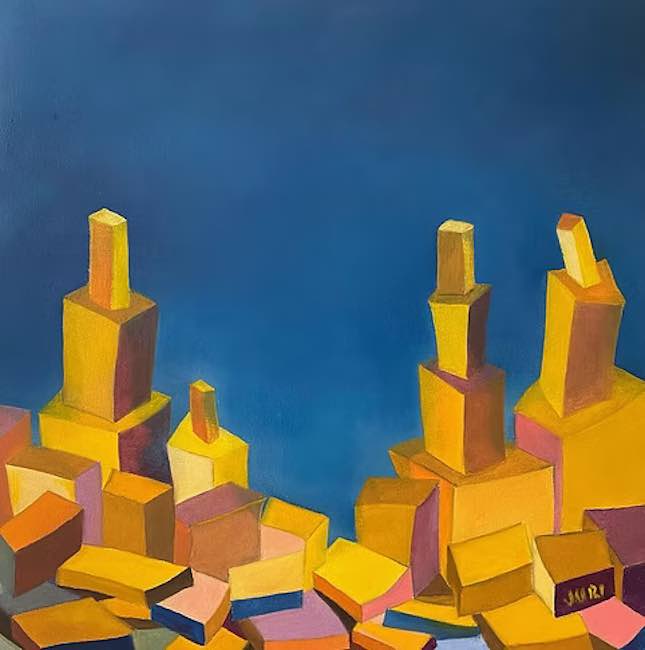
La scomposizione in figure geometriche mostra la sua attitudine più razionale, quella che lo induce a racchiudere la realtà all’interno di confini conosciuti, di schemi basilari per l’esplorazione dell’osservato e che contraddistinguono la caratteristica più evidente dei suoi lavori; un attimo dopo però è impossibile non lasciarsi prendere per mano per essere condotti nel suo mondo nascosto, quello interiore, quello in cui il ricordo si veste di gioco, di piacevolezza, di sogno fanciullesco, di ricomposizione attraverso una lente di osservazione ammirata e onirica sul visibile.
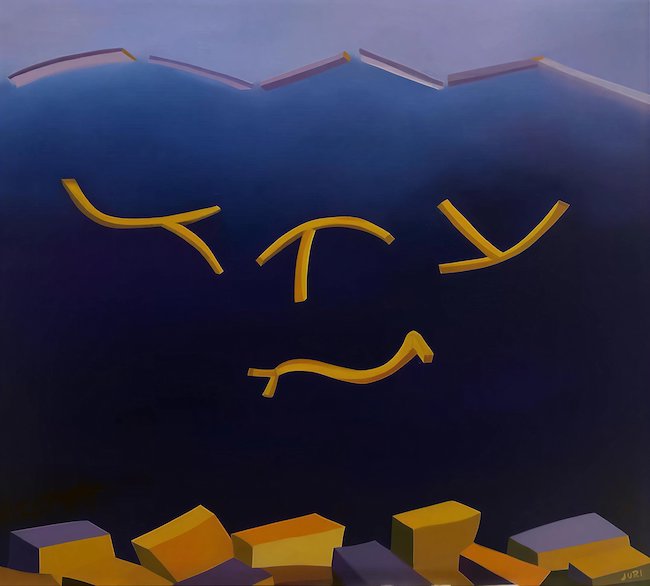
Nella nuova produzione pittorica Juri Perin racconta luoghi lontani, probabilmente tappe di un viaggio effettuato che si è tatuato nella sua memoria e che ha avuto bisogno di interiorizzare, di assorbire e infine di trasformare in cartoline emozionali, intrise di quelle sensazioni piacevoli e positive che ogni percorso di scoperta porta con sé, enfatizzando la geometricità e applicandola dove non ci si aspetterebbe di trovarla, e cioè a posti che abitualmente vengono raccontati in tutta la loro istintualità e incontaminatezza.
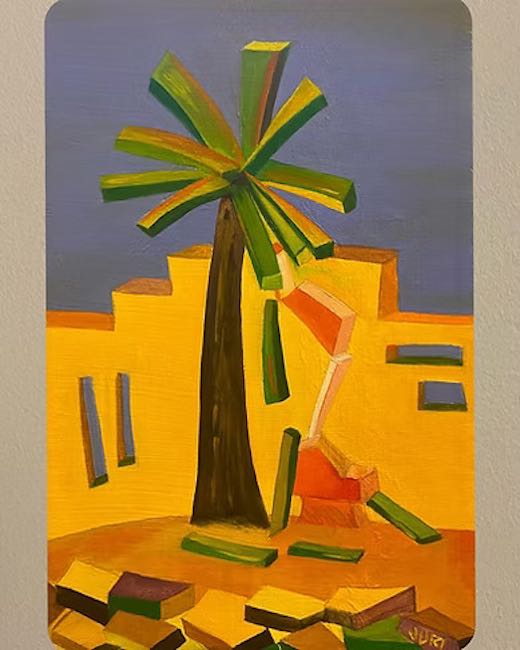
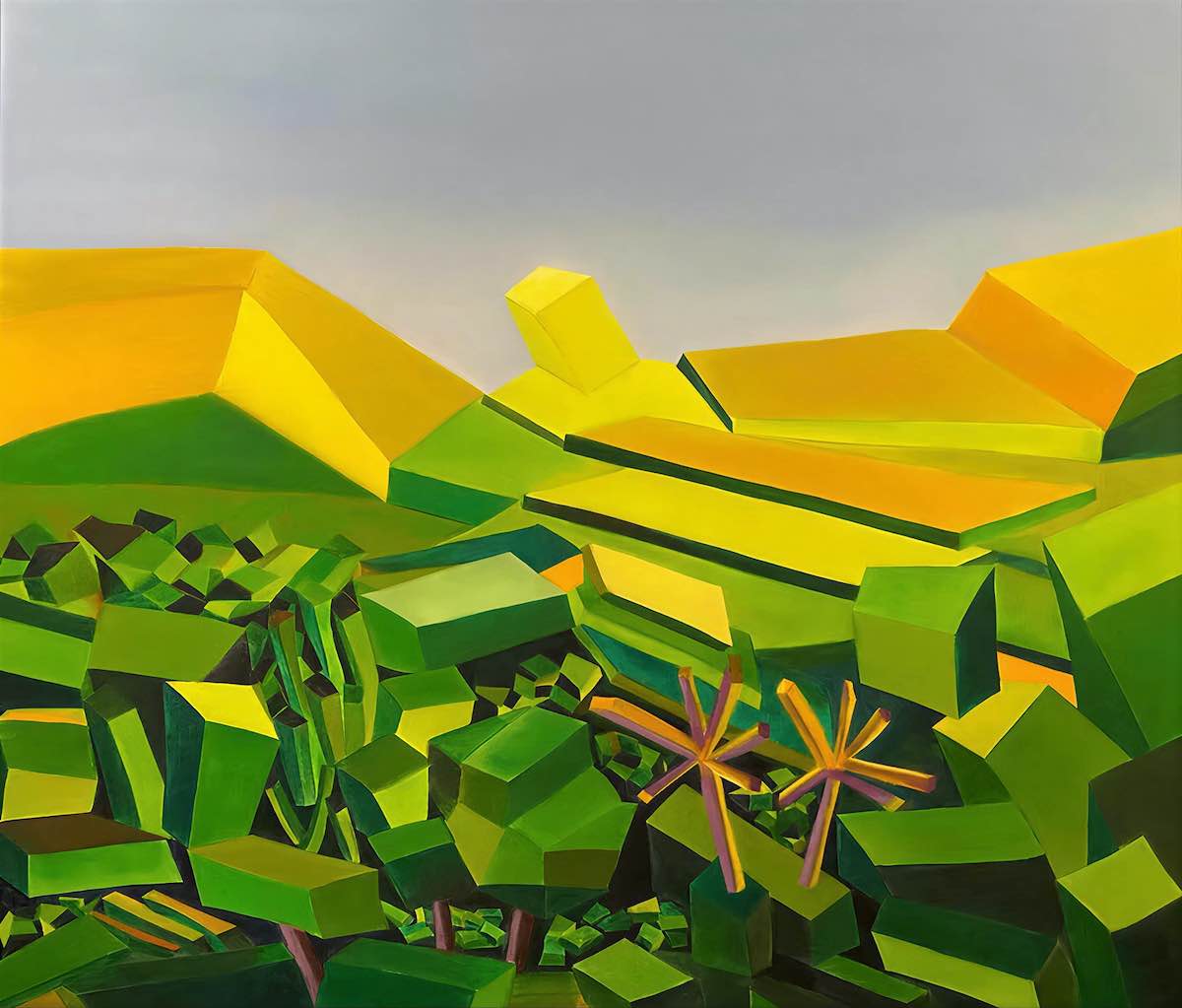
La gamma cromatica dunque si adegua alla narrazione, mostra una solarità completamente affine agli scorci raccontati mentre il Cubettismo viene applicato agli animali appartenenti agli habitat descritti, così come agli alberi e alle distese che li ospitano; la tela La potatura delle palme appartiene a questa serie di lavori in cui la luminosità prevale sulla lunarità, come se la riflessione e l’attitudine onirica di Juri Perin fossero messe in secondo piano rispetto alla meraviglia che nell’attimo dell’osservazione si è aperta davanti ai suoi occhi. Dietro alla palma, protagonista del dipinto, si staglia un muro cittadino collocando dunque la scena in un paese del Mediterraneo dove questi alberi costituiscono la base della flora locale; pertanto lo sguardo dell’osservatore corre dalla rigorosità delle fronde delle palme, rigorosamente cubettiste, alla luce intensa che sembra rimbalzare dalle pareti del muro per illuminare l’intero piccolo mondo descritto dall’autore, infondendo quella sensazione giocosa e affascinante che conquista al primo sguardo.
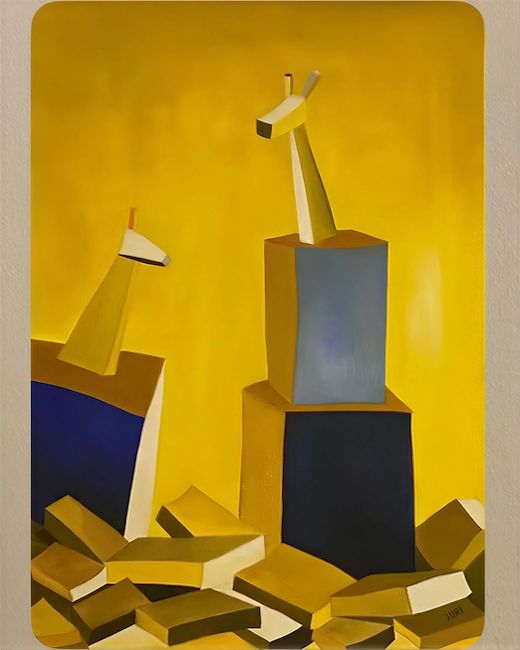
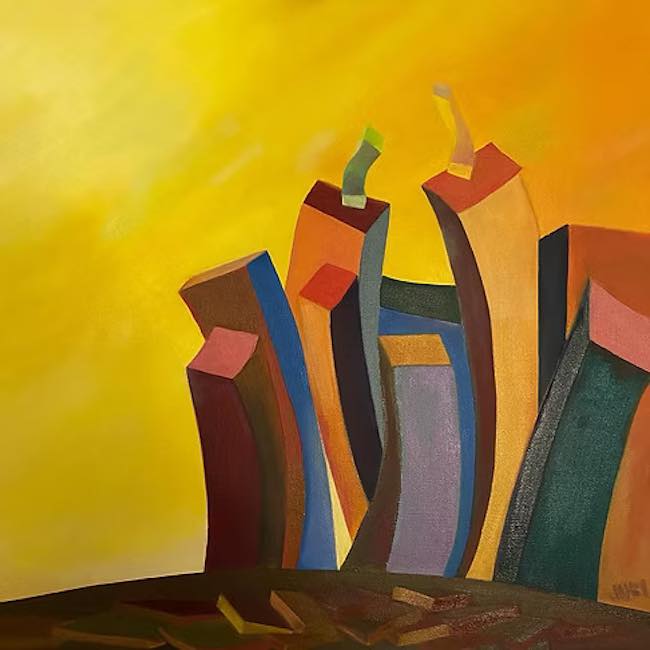
Giraffe è un dipinto persino più stilizzato, qui l’impressione è quella di trovarsi davanti a una composizione fatta con i mattoncini Lego, laddove però a compiere la geometricizzazione è la spontanea attitudine narrativa di Juri Perin, quel suo camminare costantemente sul filo del suo dualismo interiore che gli ha permesso di creare un linguaggio espressivo tanto unico ma soprattutto necessario a consentirgli di conciliare le sue due anime. Nel rappresentare la savana, l’autore sceglie uno sfondo giallo ocra, quasi dorato, e scompone i corpi degli altissimi animali dandogli una struttura ben più solida di quella che abitualmente hanno, sottintendendo quanto in fondo essi riescano a equilibrare sottigliezza delle zampe con un corpo più pesante e con un collo incredibilmente lungo. In qualche modo questa tela potrebbe essere interpretata come una metafora di un essere umano che, pur facendo spesso fatica a restare in piedi contro gli eventi che sembrano travolgerlo, riesca a farlo sorprendendo se stesso e apprendendo a guardare il lato più luminoso generato dalla consapevolezza della propria forza che segue alla tempesta appena superata.
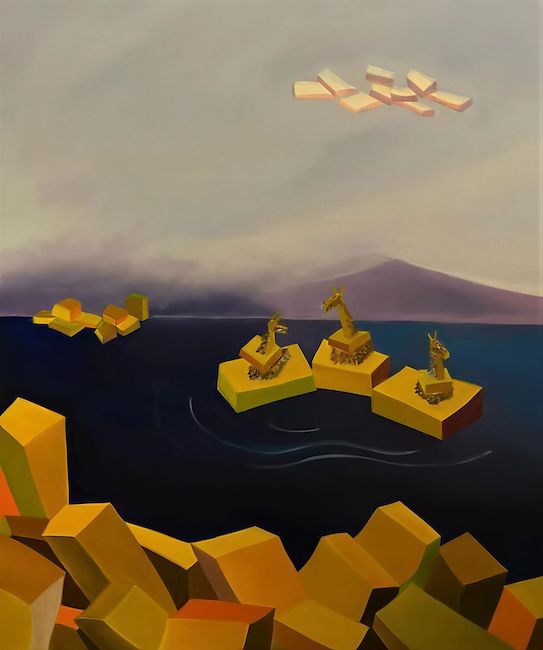
L’opera Lago con alpaca è forse la più ironica di questa nuova produzione poiché Juri Perin colloca i camelidi sopra dei cubi, che evocano piccole imbarcazioni, e protetti da qualcosa di molto simile ai salvagente, descrizione piuttosto improbabile dal momento che nessun animale brado accetterebbe di farsi intrappolare all’interno di un accessorio simile. Eppure sarebbe impossibile per loro attraversare lo specchio d’acqua senza adeguarsi a quel tipo di presidio e dunque, ancora una volta, diviene evidente l’allegoria sull’uomo che, malgrado la ribellione e il desiderio di vivere secondo le proprie regole e di agire senza riflettere sulle conseguenze, deve prima o poi adattarsi a ciò che è funzionale alla propria sopravvivenza. L’atmosfera che ne fuoriesce è tuttavia divertente, sembra appartenere al sogno di un bambino in cui tutto è riconducibile a ciò che conosce e alle abitudini apprese e insegnategli, dunque anche il mondo animale e i luoghi lontani e immaginati si trasformano in visioni simili al quotidiano.
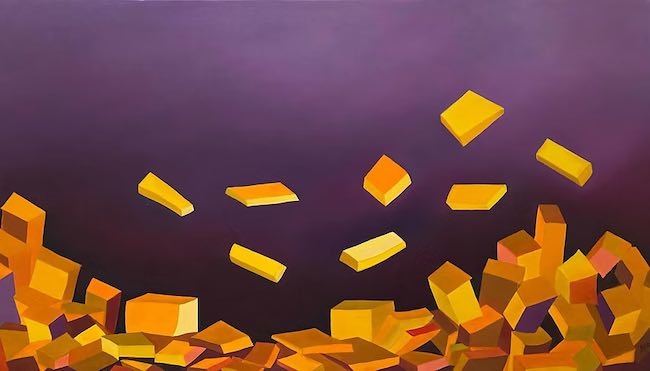
Per Juri Perin la rigorosità è complementare alla capacità di emozionarsi, è esattamente in virtù di questa contrapposizione che il suo istinto creativo trova realizzazione e compimento, perché in fondo l’essere umano adulto ha bisogno di trovare una via d’uscita dalla logica e dal pragmatismo che contraddistingue la vita odierna, e, di contro, il bambino interiore all’interno di ciascuno, necessita quegli schemi logici che costituiscono la base del suo percorso di consapevolezza.
Juri Perin ha al suo attivo la partecipazione a più di 40 mostre nazionali ed internazionali, un percorso espositivo iniziato 13 anni fa, tra cui spicca la partecipazione alla 60° Biennale di Venezia; è stato inserito nell’Atlante dell’Arte Contemporanea De Agostini e nel Catalogo dell’Arte Moderna Mondadori dal n. da 57 al n. 61.
JURI PERIN-CONTATTI
Email: juriandrea.perin@gmail.com
Sito web: www.juriperin.it/
Facebook: www.facebook.com/profile.php?id=100000761553813
Instagram: www.instagram.com/juriperin/
Dreamlike visions and emotional simplicity in Juri Perin’s Cubettism
At times art becomes an opportunity to reveal an inner world torn between the need to let go and embrace one’s most emotional side, and the habit of maintaining a strong connection with one’s more rational, reflective, and meditative side; thus, creative expression is a middle ground where these two different, and only seemingly opposed, sides of the soul can coexist in perfect balance, finding a style akin to an indispensable dualism for this kind of interpreters. Figurative art, therefore, breaks its ties with reality to transcend the visible transforming it into the emanation of an observational approach that goes to the essence, to the core, of everything captured by the gaze because the inevitable interplay between mind and instinct serves to generate a language that is as novel and fascinating as it is spontaneous for those who find themselves before works of this kind. Juri Perin belongs precisely to this category of artists for whom painting is equivalent to revealing the dualism of his inner nature and, consequently, expressive.
From an artistic perspective, the early Twentieth century brought with it discoveries and experiments that had emerged during the second half of the Nineteenth century, developments that could serve as a foundation for bolder new explorations better aligned with the epochal shifts being generated by a society that was rapidly accelerating across every sphere. Among the most radical insights of previous years was that of the Impressionists, since the fragmentation of the brushstroke used to construct an image faithful to reality solely through the juxtaposition of colors, no longer obtained by mixing them on the palette and then layering them on the canvas but rather applied in their pure form prompting the viewer to step back from the painting to see the final effect, led the key figures of the early new century to delve into the very theme of fragmentation. Futurism and Cubism were the two avant-garde movements that severed all ties with traditional aesthetics, which remained central to the masters of Impressionism, by emphasizing and pushing to an extreme the very concept of decomposition extending it to the entire figure going well beyond mere color and its rendering, thereby transforming the resulting vision. Pablo Picasso and Georges Braque on one side, Filippo Tommaso Marinetti and Umberto Boccioni on the other, demonstrated how deconstruction could combine scientific and logical analysis with an inner sensibility that inevitably spilled out from their canvases, even though the intentions of both movements tended to push the emotional realm into the background. Also Surrealism, which retained traditional figuration while pushing it toward the realm of the absurd, the unusual, the unsettling, and the destabilizing, deconstructed real-world settings in its own way to introduce anthropomorphic characters, post-apocalyptic atmospheres, monsters of the mind, and in the movement’s most Metaphysical sense as exemplified by the Belgian René Magritte, visual games in which emerged enigmas and oddities, ironically brought to light through his artworks. Even in the case of Surrealism, despite the desire of its adherents to push the emotional sphere into the background, thereby contrasting with Expressionism where subjectivity was absolutely predominant, it is impossible not to notice the thoughts and and the feelings of the artist, whether in the case of the more cerebral Magritte or the more unsettling Dalí and Ernst, because in all of them emerged the dreamlike world that could not help but be linked to instinct and irrationality.
Despite the distance these movements sought to maintain from one another, there were artists who reconciled their differences, giving rise to a unique and captivating expressive language such as Giorgio Morandi, for whom the geometric rigor of his figures was softened by a Metaphysical, and also emotional, reflection on the intrinsic value of everything belonging to everyday life becoming an indispensable confirmation and certainty. The Milanese artist Juri Perin, in turn, combines in his style not only the two extremes of expression, the more analytical and rational and the one that cannot help but attune itself to the magic around him, with that simplicity that leads his inner self to open up and envelop his canvases in the spontaneous and intuitive sensibility with which he observes everything happening around him, but he also blends the characteristics of two of the movements mentioned earlier, Cubism and Surrealism, giving rise to a style that can be defined as Cubettism. The decomposition into geometric figures reveals his more rational side that leads him to enclose reality within known boundaries and basic patterns for exploring the observed world, elements that distinguish the most evident characteristic of his works; a moment later, however, it is impossible not to let oneself be taken by the hand and led into his hidden world, the inner one, where memory takes on the form of play, of pleasure, of a childlike dream, and of recomposition through an admiring and dreamlike lens focused on the visible. In his new series of paintings, Juri Perin depicts distant places, likely stops along a journey that has become etched in his memory and that he needed to internalize, absorb, and ultimately transform into emotional postcards, imbued with the pleasant and positive sensations that every journey of discovery brings, emphasizing geometric forms and applying them where one would least expect to find them, namely in places that are usually depicted in all their instinctual and unspoiled nature.
The color palette thus adapts to the narrative, displaying a radiance that perfectly matches the scenes depicted, while Cubettism is applied to the animals inhabiting the described habitats, as well as to the trees and expanses that host them; the painting La potatura delle palme (Pruning the Palm Trees) belongs to this series of paintings in which luminosity prevails over a lunar atmosphere, as if Juri Perin’s reflection and dreamlike sensibility were pushed into the background compared to the wonder that, in the moment of observation, unfolded before his eyes. Behind the palm tree, the painting’s central figure, a city wall stands out, thus situating the scene in a Mediterranean country where these trees form the basis of the local flora; consequently, the viewer’s gaze travels from the precision of the palm fronds, strictly Cubettist in style, to the intense light that seems to bounce off the wall to illuminate the entire little world depicted by the artist, instilling that playful and captivating feeling that wins over at first glance. Giraffe (Giraffes) is an even more stylized artwork, here the impression is that of standing before a composition made of Lego bricks, though in this case it is Juri Perin’s spontaneous narrative flair that achieves this geometricization, that constant walking on the tightrope of his inner dualism that has allowed him to create an expressive language so unique, yet above all necessary, to enable him to reconcile his two souls.
In depicting the savanna the artist chooses an ochre-yellow, almost golden background and deconstructs the bodies of these towering animals, giving them a structure far more solid than they usually have, implying just how well they manage to balance the delicacy of their legs with a heavier body and an incredibly long neck. In some ways, this canvas could be interpreted as a metaphor for a human being who, while often struggling to stay on his feet in the face of events that seem to overwhelm him, manages to do so by surprising himself and learning to look toward the brighter side, a perspective born of the awareness of his own strength that follows the storm he has just weathered. The painting Lago con alpaca (Lake with Alpacas) is perhaps the most ironic of this new series, as Juri Perin places the camelids atop cubes, which evoke small boats, and protects them with something very similar to life preservers, a rather improbable depiction given that no wild animal would agree to be trapped inside such a device. And yet, it would be impossible for them to cross the stretch of water without conforming to that particular set of requirements thus, once again, the allegory becomes clear, it concerns humanity which despite its rebelliousness and desire to live by its own rules and act without reflecting on the consequences, must sooner or later adapt to whatever is essential for its own survival.
The atmosphere that emerges, however, is playful, it seems to belong to a child’s dream in which everything can be traced back to what the child knows and to the habits learned and taught to him thus even the animal world and distant, imagined places are transformed into visions reminiscent of everyday life. For Juri Perin rigor goes hand in hand with the ability to feel emotion, it is precisely through this contrast that his creative instinct finds expression and fulfillment because, after all, adult human beings need to find a way out of the logic and pragmatism that characterize modern life, and conversel, the inner child within each of us needs those logical frameworks that form the foundation of our journey toward self-awareness. Juri Perin has participated in more than 40 national and international exhibitions—an exhibition career that began 13 years ago, including most notably the 60th Venice Biennale; he has been featured in the De Agostini Atlas of Contemporary Art and in the Mondadori Catalog of Modern Art from issues 57 through 61.