

Nel momento in cui la creatività diviene espressione di una ricerca profonda sulla storia, sulle origini della spiritualità e sulle antiche civiltà, ogni opera rappresenta un percorso pieno di narrazioni sottili che fuoriescono in maniera sussurrata chiedendo un sforzo di comprensione piuttosto che una pura e semplice osservazione; questo è in particolar modo vero quando gli autori tendono a non scegliere uno stile espressivo diretto e figurativamente immediato bensì optano per un linguaggio più criptico e affine alla loro natura sperimentatrice. L’artista di cui vi racconterò oggi mescola tra loro stili pittorici e scultorei al di fuori degli schemi tradizionali e soprattutto introduce il concetto del riutilizzo di materiali che possono trasformare il loro ciclo vitale per diventare parte di un’opera d’arte.
Il Ventesimo secolo costituì una vera e propria fucina di idee in virtù delle quali il mondo dell’arte modificò completamente non solo il suo aspetto ma anche il suo intento espressivo poiché la semplice raffigurazione dell’osservato non era più sufficiente a permettere agli autori di quel tempo di lasciar fuoriuscire le nuove idee, sovversive e rivoluzionarie, che ribollivano all’interno di un periodo storico di trasformazione della società e del modo di vivere. Dopo le innovazioni costituite dall’Espressionismo e dall’Arte Astratta, dopo le sperimentazioni del Futurismo, del Cubismo e del Surrealismo, dopo aver deciso di mettere l’uomo e il suo sentire emozionale e psicologico al centro della ricerca pittorica e scultorea, dopo aver superato il senso tragico dei conflitti mondiali, venne un tempo in cui il messaggio artistico divenne persino più sperimentale, volto a oltrepassare gli ostacoli e i limiti costituiti dalle rigidità formali precedenti e in cui fosse possibile mescolare esperienze e ricerca di nuove opportunità realizzative.
Fu esattamente in questo contesto, intorno alla metà del Novecento, che nacquero linguaggi volti a esplorare un senso diverso del fare arte, integrando all’interno delle opere dei diversi movimenti, anche le tecniche artigianali, che tanto erano state fondamentali nell’Art Nouveau, così come l’utilizzo di materiali non convenzionali, o l’apertura verso un tipo di approccio esecutivo completamente privo di qualsiasi linea guida. In questo contesto rientrano stili diversi tra loro eppure quasi complementari nel loro essere anticonvenzionali: il Nouveau Réalisme si orientò all’utilizzo di materiali da conformare, lacerandoli, spezzandoli, rompendoli, all’intuizione creativa del singolo interprete, come gli specchi, le ceramiche, la plastica per Nicki de Saint Phalle, o la carta dei manifesti strappata e poi ricomposta in maniera disordinata sotto forma di collage dagli affichistes come Mimmo Rotella. L’Art Brut presupponeva invece una necessità interiore di liberare le proprie emozioni come forma di guarigione, senza la conoscenza di alcuna base accademica e cromatica, dal disagio mentale; fu Jean Dubuffet a dare denominazione a questo tipo di arte utilizzata nei sanatori per permettere ai pazienti di sfogare i propri turbamenti canalizzandoli in un processo creativo rigenerante per l’anima.
E infine l’Arte Povera, in cui la tela addirittura veniva eliminata per mettere in risalto la materia al suo stato originario, quasi senza intervento da parte dell’autore se non dal punto di vista interpretativo, oppure al contrario mescolando parti di elementi con cui veniva sottolineata la primordialità del gesto artistico. Questi furono i movimenti che gettarono le basi per l’Arte del Riciclo contemporanea dove l’attenzione all’ambiente e a tutto ciò che può essere recuperato e trasformato, si coniuga a una non considerazione della perfezione della forma, perché ciò che più di tutto conta è il concetto e il significante di un’opera.
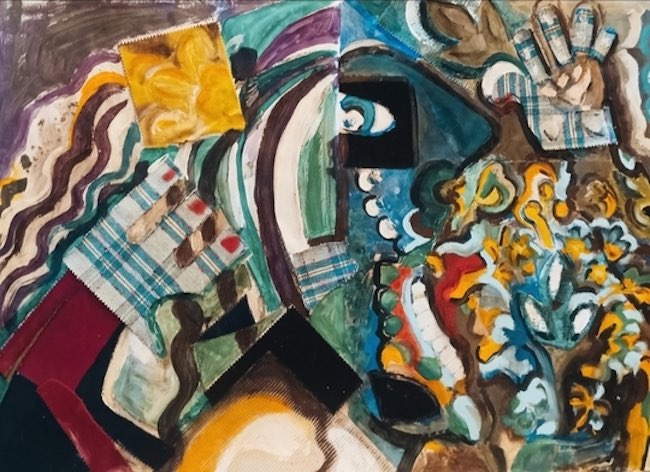
L’artista emiliana Letizia Cucciarelli attinge alle esperienze delle esplorazioni artistiche appena descritte, mescolandole per elaborare un suo stile personale e decisamente distintivo in cui si rivelano le diverse anime dell’autrice: quella intellettuale che la spinge a narrare frammenti di eventi storici appartenenti a un antico passato tanto quanto rappresentazioni religiose o legate ai dogmi cattolici; quella affascinata dalla possibilità di utilizzare materiali di uso comune per andare a comporre opere in cui la figurazione si nasconde sotto l’astrazione o forse sarebbe più corretto dire sotto una frammentazione dell’immagine dove Cubismo, Astrattismo, Nouveau Réalisme e Arte del Riciclo si sovrappongono per spiegare il concetto di base. E infine l’anima sperimentatrice che si rivela sia con le innovative tecniche esecutive e sia con la fusione di mezzi pittorici abitualmente considerati estranei al mondo dell’arte eppure incredibilmente in grado di dar vita a sinergie intense e affascinanti dal punto di vista tecnico.
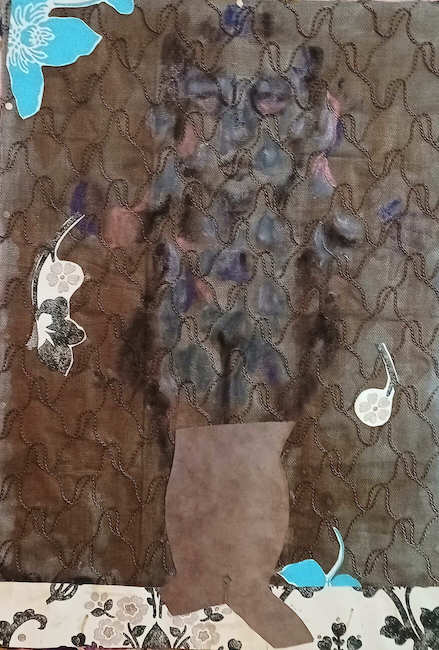
Letizia Cucciarelli divide le sue opere in gruppi esecutivi, come la serie Ecollage 2025 creata con materiali di recupero industriali o artigianali e volta a suggerire il messaggio di arte sostenibile integrata dall’uso di una pittura più ecologica possibile; questo concetto diviene dunque prolungamento ed evoluzione di quell’Arte Povera della metà del Novecento e rientra in pieno nella linea dell’Arte del Riciclo poiché ogni tela costituisce una testimonianza di come il recupero di materiali ormai inutilizzati nella loro funzione primaria, possano trovare un nuovo corso vitale stimolando negli artisti appartenenti a questo movimento un costante ispirazione.
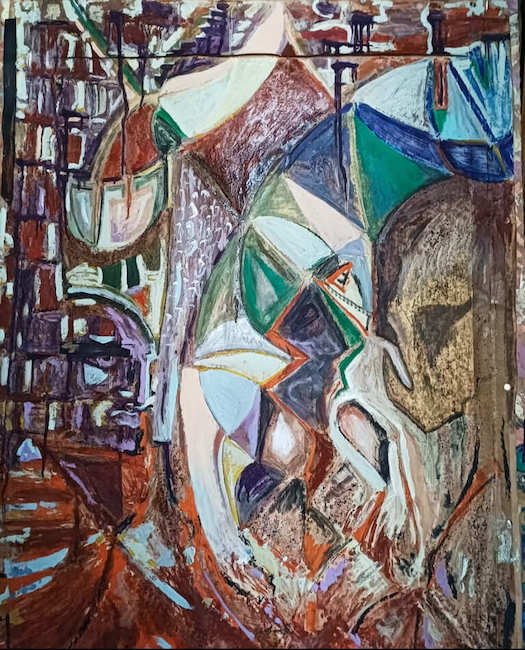
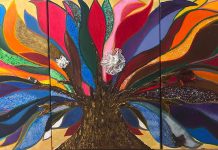
Ma la natura sperimentatrice di Letizia Cucciarelli raggiunge la sua massima realizzazione fondendo la pittura ad acrilico con sostanze insolite, complesse da amalgamare, ma che rappresentano per lei una continua sfida generativa; questo è il caso dell’opera La battaglia dei Bruzi, che fa parte di un trittico esposto al museo MAM di Cosenza per la mostra intitolata alla Donna Brettia e che le è valso un primo premio assoluto, per cui l’autrice ha applicato per la prima volta la pittura a base di miele, pigmenti e resine su un supporto di carta metallizzata di recupero in lastre da stampa Kodak. L’uso di questi materiali è ispirato all’archeologia e dunque alle prime espressioni artistiche umane rappresentate dai pittogrammi eseguiti con utilizzo di resine e ocre, ancora intatti dopo oltre diecimila anni.
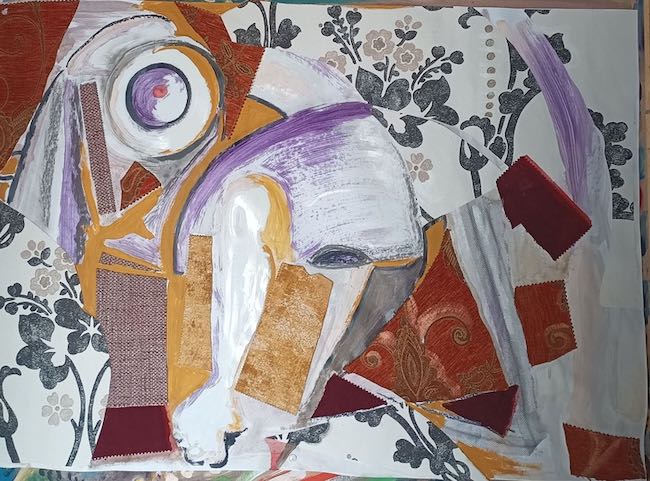
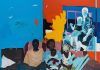
Il dipinto Il manipolatore appartiene invece alla serie Vizi e virtù e mostra l’approccio nouveau réaliste di Letizia Cucciarelli poiché la composizione è costituita da ritagli di carta da parati e stoffe, poi completati da pittura acrilica e tempera su supporto di carta zigrinata da stampa, dunque andando a concretizzare sia l’attitudine al collage che ricomponeva frammenti di elementi ritagliati, o strappati o trovati casualmente tipica degli affischites, e sia quella tendenza a donare una nuova forma di esistenza a quei materiali che diversamente verrebbero smaltiti senza alcuna possibilità di prolungare la loro utilità. In questo lavoro la confusione visiva, la frammentazione apparente, enfatizza l’attitudine di tutte quelle persone incapaci di avere un atteggiamento lineare e trasparente al punto di dover modificare la realtà sulla base del proprio interesse personale, generando instabilità logica e poca chiarezza funzionali a ottenere i proprio obiettivi.
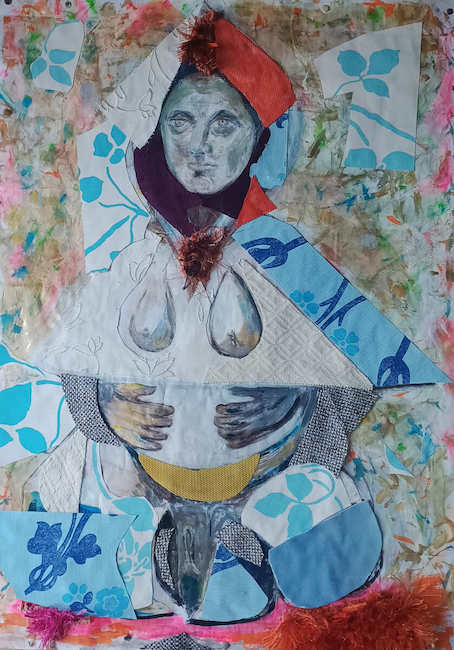
Plastic Venus Yellow Fat appartiene invece a una serie di sei disegni ispirati alle veneri preistoriche di pietra che l’autrice ha rielaborato in versione terzo millennio introducendo in questi lavori l’elemento che più di tutti ha caratterizzato l’ultimo secolo e cioè la plastica, ribadendo così la sua sensibilità nei confronti della tematica ecologica; anche qui il supporto è una carta zigrinata da tipografia su cui sono applicate stoffe, carta da parati, moquette di recupero e gesso completati con pittura ad acrilico e tempera.
L’aspetto florido e lo sguardo serafico svelano l’appartenenza della figura a un mondo lontano, quasi queste divinità fossero assolutamente arcaiche nel presente, eppure Letizia Cucciarelli rende attuale la dea proprio in virtù dei frammenti di materiali con cui la circonda, come se in qualche modo volesse ricordare all’osservatore i simboli che ella rappresenta, l’importanza dell’armonia nelle relazioni, la bellezza intesa nel senso più esteso del termine, dunque esteriore quanto interiore, l’amore e l’interazione con gli altri, valori ormai quasi dimenticati nella società contemporanea.
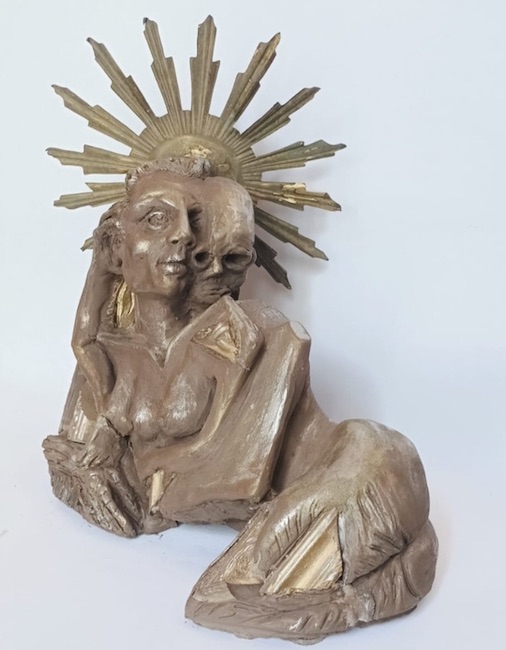
Una personalità eclettica come quella della Cucciarelli non poteva non misurarsi anche con la scultura, in cui mostra la sua vena più legata all’Art Brut nella rappresentazione visiva, come in Santa Pazienza, sempre appartenente alla serie Vizi e Virtù, in cui la divinità-totem sembra evocare le iconografie indigene, ma per eseguire la quale mescola, ancora una volta, materiali insoliti alla base in creta e che si trovano nell’aureola composta da metallo antico, spillone da cappello e pezzi di cornice in legno di recupero.
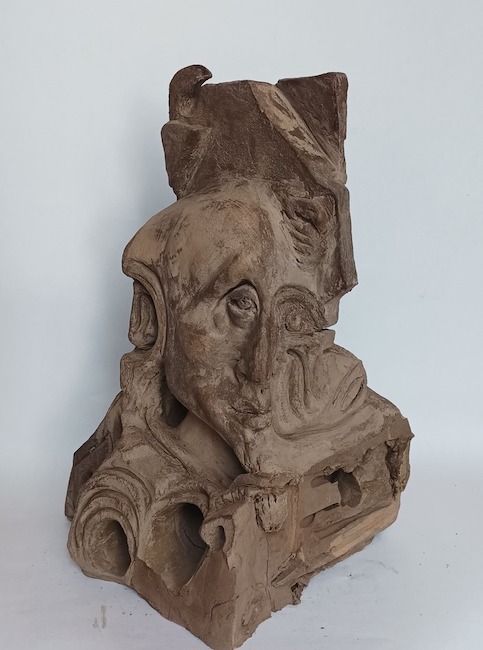
Letizia Cucciarelli ha al suo attivo molte mostre personali, la partecipazione a innumerevoli mostre collettive in Italia e all’estero, ha vinto svariati premi artistici di cui uno alla carriera, e le sue opere sono inserite da diversi anni nel Catalogo dell’Arte Moderna Giorgio Mondadori.
LETIZIA CUCCIARELLI-CONTATTI
Email: cucciarelliletizia@gmail.com
Facebook: www.facebook.com/letizia.cucciarelli
Instagram: www.instagram.com/letiziacucciarelli/
Nouveau Réalisme, Brut Art and Recycling Art in the intellectual and original works by Letizia Cucciarelli
At a time when creativity becomes an expression of deep research into history, the origins of spirituality and ancient civilizations, each work represents a path full of subtle narratives that emerge in a whispered manner asking for an effort of comprehension rather than mere observation; this is especially true when the authors tend not to choose a direct and figuratively immediate expressive style but opt for a more cryptic language akin to their experimental nature. The artist I am going to tell you about today mixes together pictorial and sculptural styles outside traditional patterns and, above all, introduces the concept of reusing materials that can transform their life cycle to become part of a work of art.
The twentieth century constituted a veritable hotbed of ideas by virtue of which the art world completely altered not only its appearance but also its expressive intent since the mere depiction of the observed was no longer sufficient to allow the authors of that time to let out the new, subversive and revolutionary ideas that were simmering within a historical period of transformation of society and way of life. After the innovations constituted by Expressionism and Abstract Art, after the experiments of Futurism, Cubism and Surrealism, after deciding to put man and his emotional and psychological feeling at the center of pictorial and sculptural research, after overcoming the tragic sense of world conflicts, there came a time when the artistic message became even more experimental, aimed at going beyond the obstacles and limitations constituted by previous formal rigidities and in which it was possible to mix experiences and the search for new opportunities for realization.
It was exactly in this context, around the middle of the twentieth century, that were born languages aimed at exploring a different sense of art making, integrating within the works of the different movements, even the craft techniques, which had been so fundamental in Art Nouveau, as well as the use of unconventional materials, or the openness to a type of executive approach completely devoid of any guidelines. This includes styles that are different from each other and yet almost complementary in their being unconventional: Nouveau Réalisme was oriented toward the use of materials to be conformed, tearing them, breaking them, to the creative intuition of the individual author, such as mirrors, ceramics, and plastic for Nicki de Saint Phalle, or poster paper torn and then haphazardly reassembled in the form of collage by affichistes like Mimmo Rotella.
Art Brut, on the other hand, presupposed an inner need to release one’s emotions as a form of healing, without the knowledge of any academic or chromatic basis, from mental distress; it was Jean Dubuffet who gave a name to this type of art used in sanatoriums to allow patients to vent their turmoil by channeling it into a creative process regenerative for the soul. And finally Arte Povera, in which the canvas was even eliminated to emphasize the material in its original state, almost without intervention by the author except from the point of view of interpretation, or on the contrary by mixing parts of elements with which was put in evidence the primordiality of the artistic gesture. These were the movements that laid the foundations for contemporary Recycling Art where attention to the environment and to everything that can be recovered and transformed is combined with a disregard for the perfection of form, because what matters most of all is the concept and the signifier of a work.
The Emilian artist Letizia Cucciarelli draws on the experiences of the artistic explorations just described, mixing them to elaborate her own personal and decidedly distinctive style in which are revealed the different souls of the author: the intellectual one that pushes her to narrate fragments of historical events belonging to an ancient past as much as religious representations or those linked to Catholic dogmas; the one fascinated by the possibility of using everyday materials to go on to compose artworks in which figuration is hidden under abstraction or perhaps it would be more correct to say under a fragmentation of the image where Cubism, Abstractionism, Nouveau Réalisme and Art of Recycling overlap to explain the basic concept. And finally, the experimental soul that reveals itself both with the innovative execution techniques and with the fusion of pictorial media habitually considered extraneous to the art world and yet incredibly capable of creating intense and technically fascinating synergies. Letizia Cucciarelli divides her artworks into executive groups, such as the Ecollage 2025 series created with industrial or artisanal salvaged materials and aimed at suggesting the message of sustainable art complemented by the use of the most ecological painting possible; this concept thus becomes an extension and evolution of that Arte Povera of the mid-twentieth century and falls fully within the line of the Art of Recycling since each canvas constitutes a testimony of how the recovery of materials now unused in their primary function, can find a new vital course by stimulating in the artists belonging to this movement a constant inspiration.
But Letizia Cucciarelli‘s experimental nature reaches its fullest realization by blending acrylic painting with unusual substances that are complex to amalgamate, but which represent a continuous generative challenge for her; this is the case with the artwork La battaglia dei Bruzi (The Battle of the Bruzi), which is part of a triptych exhibited at the MAM museum in Cosenza for the exhibition entitled Donna Brettia and which won her an overall first prize, for which the author applied for the first time honey-based paint, pigments and resins on a support of recycled metallized paper in Kodak printing plates. The use of these materials is inspired by archaeology and thus by the earliest human artistic expressions represented by pictograms executed using resins and ochres, still intact after more than ten thousand years.
The painting Il Manipolatore (The Manipulator), on the other hand, belongs to the series Vizi e Virtù (Vices and Virtues) and shows Letizia Cucciarelli‘s nouveau réaliste approach since the composition consists of wallpaper and fabric cutouts, then completed by acrylic paint and tempera on a knurled paper printing support, therefore going to concretize both the attitude to collage that recomposed fragments of cut-out, or found by chance typical of affischites, and both that tendency to give a new form of existence to those materials that would otherwise be disposed of without any possibility of prolonging their usefulness. In this work, the visual confusion, the apparent fragmentation, underelines the attitude of all those people who are incapable of having a linear and transparent behaviour to the point of having to modify reality on the basis of their own self-interest, generating logical instability and little clarity that is functional to obtain their own goals.
Plastic Venus Yellow Fat, on the other hand, belongs to a series of six drawings inspired by prehistoric stone Venuses that the author has reworked in a third-millennium version, introducing into these works the element that has characterized the last century most of all, namely plastic, thus reaffirming her sensitivity to ecological issues; here, too, the support is a knurled typography paper on which are applied fabrics, wallpaper, salvaged carpeting and plaster completed with acrylic and tempera paint. The florid appearance and seraphic gaze reveal the figure’s belonging to a distant world, almost as if these deities were absolutely archaic in the present, yet Letizia Cucciarelli makes the goddess current precisely by virtue of the fragments of materials with which she surrounds her, as if somehow wanting to remind the viewer of the symbols she represents, the importance of harmony in relationships, beauty understood in the broadest sense of the term, thus exterior as much as interior, love and interaction with others, values now almost forgotten in contemporary society.
An eclectic personality such as Cucciarelli‘s could not fail to measure herself also with sculpture, in which she shows her vein more related to Art Brut in visual representation, as in Santa Pazienza (Holy Patience), again belonging to the series Vizi e Virtù (Vices and Virtues), in which the deity-totem seems to evoke indigenous iconographies, but to execute which she mixes, once again, unusual materials to the clay base and found in the halo composed of antique metal, hat pin and pieces of salvaged wood frame. Letizia Cucciarelli has to her credit many solo exhibitions, participation in countless group shows in Italy and abroad, has won several art awards including one for lifetime achievement, and her works have been included in the Giorgio Mondadori Catalogue of Modern Art for several years.