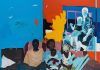


Tutto ciò che viene osservato attraverso lo sguardo viene successivamente assorbito, amplificato e trasformato dall’anima la quale sa andare oltre l’oggettività, approfondisce, indaga in maniera autonoma e distaccata dalla razionalità, tutte quelle sfumature che altrimenti sfuggirebbero, quasi la superficie venisse scavata e portata a galla sulla base del sentire dell’interprete che utilizza questo tipo di approccio espressivo. La protagonista di oggi modifica letteralmente la realtà in una maniera insolita, nel senso che lo stile è innegabilmente iperrealista per la caratteristica di saper raccontare i volti da cui viene colpita e impressionata per l’intenso interiore che lasciano trapelare, pur aggiungendo un tocco di rarefazione che sospende la contingenza per entrare nell’universo dell’intuito, del sussurrato, della scoperta dell’essenza che ciascun personaggio comunica a chi è capace di ascoltare in maniera sottile.
Intorno alla metà del Diciannovesimo secolo, dopo l’esperienza pittorica del Romanticismo che aveva in qualche modo aperto la strada all’universo interiore, quello delle sensazioni che dall’autore di un’opera si propagavano al fruitore, vi fu un ritorno alla raffigurazione effettiva della realtà che tuttavia modificò il suo punto di interesse dai ritratti nobiliari e dalle rappresentazioni cattoliche commissionate dalla chiesa verso la gente del popolo, i lavoratori dei campi o delle fabbriche che vivevano in condizioni di indigenza eppure affascinavano proprio per la loro semplicità e umiltà. I ritratti di Jean-Franꞔois Millet e di Gustave Courbet trasmettevano tuttavia, a dispetto del loro desiderio di raccontare l’osservato senza intervento soggettivo, un legame innegabile tra protagonisti di quelle azioni spontanee proprio perché abituali ed esecutore che entrava in qualche modo in connessione con il mondo del suo soggetto.
Il Realismo si diffuse ben presto non solo in tutta Europa avendo tra i suoi protagonisti autori del calibro di Giuseppe Pellizza da Volpedo, ma anche qualche decennio dopo in America dove trovò spazio sui muri delle città grazie al lavoro di Diego Rivera oppure divenne intimista e riflessivo con il lavoro di ricerca interiore di Edward Hopper assumendo così un forte risvolto sociale, sia per far sentire le voci degli invisibili e sia per lasciar fuoriuscire il disagio del vivere anche di quella nuova società emergente che nonostante il benessere non trovava appagamento umano. Ma dopo l’esperienza realista dell’Ottocento si sviluppò anche un approccio pittorico differente, quello in cui la spiritualità e la connessione tra essere umano ed energie che ruotano intorno a esso dovevano fuoriuscire in maniera ermetica ma al contempo evidente dalle opere, associando così all’immagine reale quel legame tra mondo esterno e mondo interiore dando vita al Simbolismo. In quel caso l’interpretazione divenne predominante poiché era esattamente la soggettività dell’artista a raccontare, secondo il suo punto di vista, ciò che si poteva nascondere dietro lo schermo di uno sguardo superficiale, gettando di fatto le basi per quelle avanguardie che utilizzarono la realtà per indagare la psiche e l’interiorità dell’individuo, come fece il Surrealismo.
Il Novecento determinò pertanto la trasformazione e l’evoluzione di ciò che era stato tracciato in precedenza, a volte enfatizzando altre essenzializzando le linee guida del passato. Questo fu il caso dell’Iperrealismo, nato a metà del Ventesimo secolo come estremizzazione dell’osservazione realista che tuttavia perse quell’accezione umanistica per spingersi verso una vera e propria riproduzione fotografica dei dettagli, dei luoghi e dei simboli della società statunitense, ma soprattutto mostrando quanto l’arte potesse raggiungere una definizione impeccabile pur mantenendo l’autorialità manuale dell’artista. La pittrice austriaca Alexandra Schaffer, da molti decenni residente in Italia, evolve e collega ancor più le esperienze artistiche finora citate poiché nel suo caso il tratto iperrealista recupera l’attenzione all’interiorità, indaga le rughe, le espressioni, gli sguardi, in maniera fortemente empatica, quasi la sua capacità di cogliere tutto ciò che va oltre la facciata divenisse voce narrativa di quanto i suoi soggetti provano, sentono, percepiscono e vivono nel magico istante dell’ascolto empatico dell’autrice.
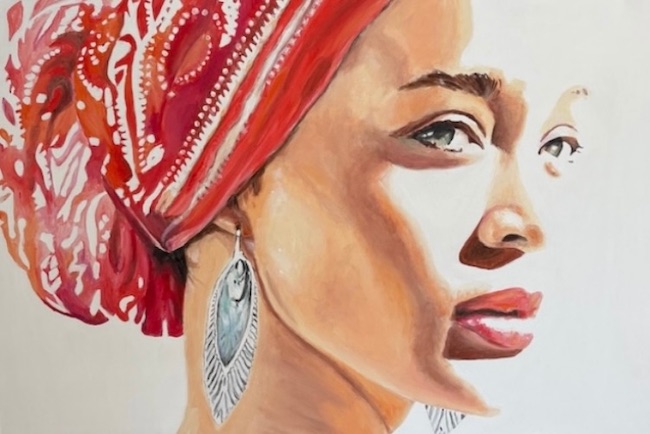
La natura umana, i suoi pensieri, le emozioni delle persone è ciò su cui si concentra la produzione pittorica di Alexandra Schaffer la quale utilizza il racconto reale per trasportare, o forse sarebbe meglio dire elevare, l’osservatore verso la dimensione magica della rarefazione, dell’essenza che conduce l’attenzione all’espressione principale, tralasciando lo sfondo, ignorando il colore della pelle, dei capelli, tutti quei tratti che indurrebbero lo sguardo a perdersi, come da tendenza contemporanea, sulla patina superficiale dimenticando ciò che rende ciascuno fortemente unico e umano.
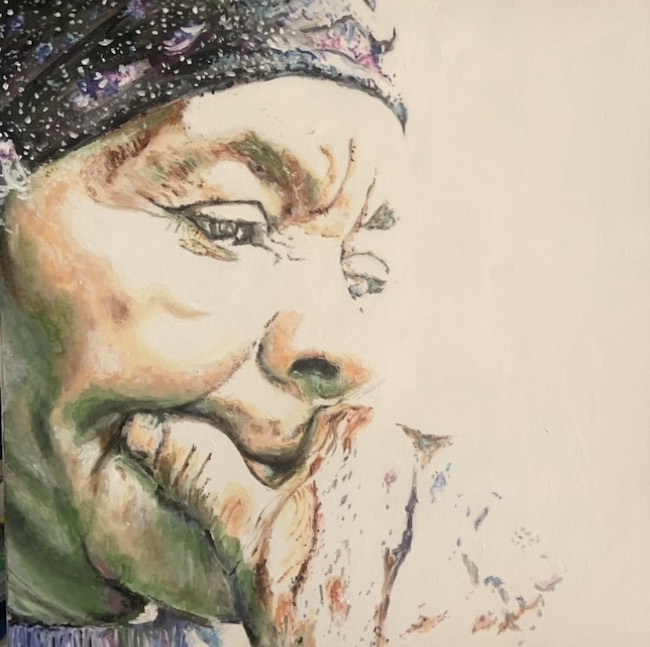
Nel mondo della perfezione dell’immagine, in cui viene richiesta l’esibizione della forma nella sua accezione più esteticamente appetibile, Alexandra Schaffer compie invece una piccola rivoluzione, lei punta alla sostanza, quella di cui sono fatte le emozioni, i sogni, le sensazioni e i desideri che ciascuno vive. La spiritualità quindi si svela esattamente in virtù dell’evanescenza dei dettagli, di quelle trasparenze che dilatano lo spazio quasi esso divenisse emanazione del sentire, quasi fosse un batuffolo di cotone che contiene, protegge ma al contempo diffonde soffusamente il riflesso interiore del personaggio collocato al suo interno.
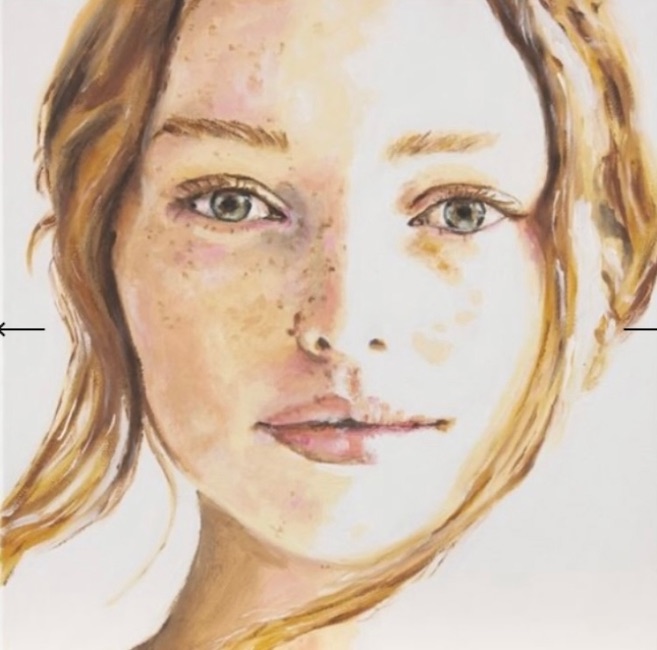
La produzione di Alexandra Schaffer si sviluppa in serie pittoriche come Volti del mondo, Io e Tu – secondo Martin Buber, The Catman of Aleppo, Africa – memoria e presenza e Dea nel colore, ciascuna delle quali mostra l’attenzione dell’autrice nei confronti di ogni persona incontrata per caso nella sua quotidianità o durante i suoi viaggi, così come la sensibilità nei confronti di tutto quel patrimonio culturale di paesi diversi e lontani tra loro eppure uniti dal comune denominatore che è la natura spirituale e al contempo umanistica che contraddistingue ciascun individuo.
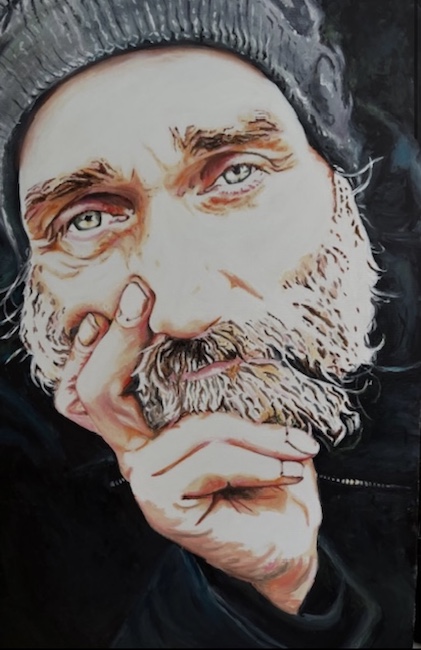
L’opera Call me Ishmael svela l’intensità emanativa di un uomo incrociato per strada, forse un clochard, forse un pescatore, forse semplicemente un volto i cui occhi hanno catturato l’attenzione di Alexandra Schaffer al punto di desiderare di entrare al loro interno, per scrutare l’anima, per ascoltare la storia silenziosa che l’uomo cela dietro il suo silenzio. La pelle, privata del contrasto cromatico, svela tutta la sua luminosità interiore, quella che racconta di esperienze vissute, di episodi a cui ha assistito, di ricordi del suo paese di provenienza e del motivo celato che lo ha spinto a lasciarlo; il focus della narrazione è tutto lì, sospeso tra il riflesso dello sguardo e la luce interiore che fuoriesce e invade l’intero volto.
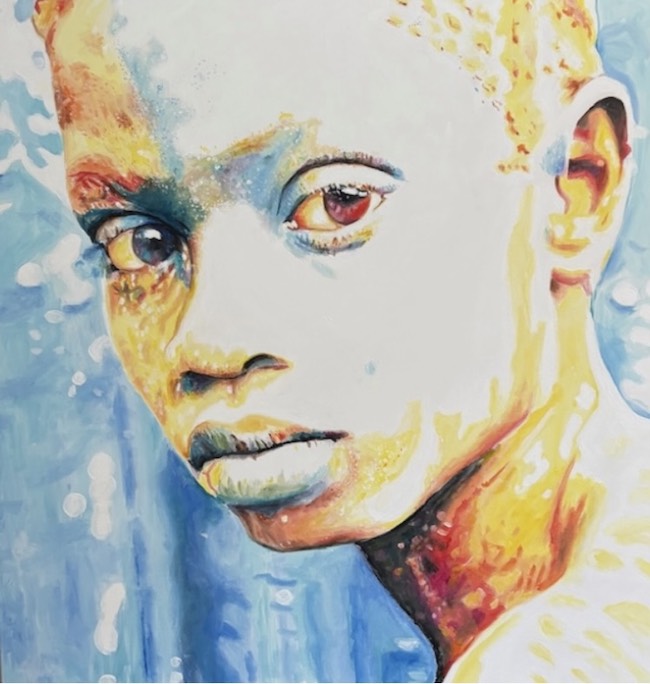
Lost in Blu racconta, al contrario, un volto la cui storia è ancora tutta da vivere, un bambino africano, lo si capisce solo dai tratti somatici, che scruta l’osservatore come ad aspettarsi risposte che potranno giungere più avanti nel suo cammino, quando avrà scelto il suo futuro sulla base delle decisioni oppure del rinunciare a perseguire i suoi sogni. Lo sfondo etereo e delicatamente blu rappresenta infatti quel mondo di desideri che appartiene all’età giovanile e che può diventare concreto se solo l’individuo comprendesse quanto di tutto ciò che accade sia determinato dal proprio atteggiamento e dalla propria volontà di cambiare un destino apparentemente ineluttabile. Il giovane uomo sembra chiedere aiuto, e Alexandra Schaffer ne esplora il volto con morbidezza materna, quasi a voler rassicurare la sua espressione imbronciata, quasi a spingerlo silenziosamente ad avere coraggio e a cambiare qualsiasi cosa non corrisponda a quei sogni a cui qualsiasi bambino ha il diritto di credere, a qualsiasi parte del mondo appartenga.
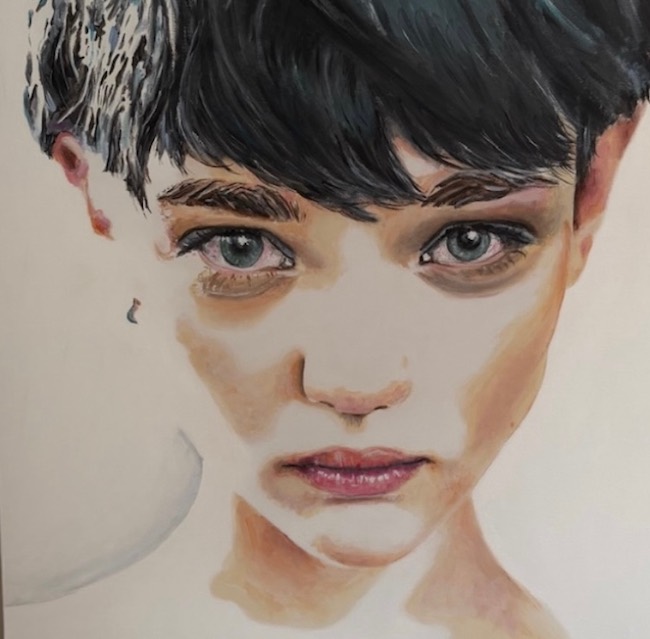
L’opera Zerbrechlichkeit (Fragilità) è particolarmente toccante, immortala una ragazza sul punto di piangere, probabilmente ferita da una persona che non ha tenuto in considerazione i suoi sentimenti, le sue emozioni delicate e bisognose di essere protette piuttosto che calpestate. Oppure è stato un evento ad aver generato la sua reazione, quasi non fosse in grado di affrontare e combattere lo svilupparsi delle circostanze trovandosi così a subirle; la luminosità dell’opera pervade quasi l’intera tela perché Alexandra Schaffer mette in luce l’evanescenza di una personalità talmente sensibile da divenire della stessa sostanza della piuma, leggera, impalpabile eppure incredibilmente profonda. Ma ciò su cui viene letteralmente calamitata l’attenzione dell’osservatore sono gli occhi, lucidi, tanto intensi da lasciar fuoriuscire l’anima, tanto espressivi da chiedere al mondo di non provocare mai più la sofferenza interiore con cui deve, suo malgrado, fare i conti ogni giorno.
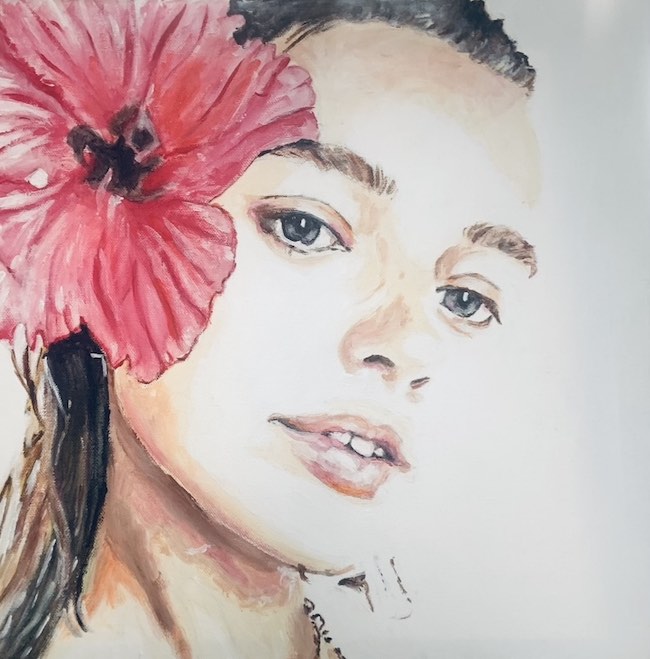
Le atmosfere dell’autrice sono pertanto costantemente avvolte da luce, silenzio, suggestione ed essenzialità e inducono l’osservatore a riflettere sull’essenza perché l’immagine, spogliata dell’apparenza verista, lascia fuoriuscire l’energia sottile che si propaga dal soggetto per raggiungere l’esterno della tela, e dunque l’osservante. Alexandra Schaffer ha al suo attivo la partecipazione a numerose esposizioni di rilievo a Roma, Firenze, L’Aquila e Dubai e le sue opere sono state sostenute dall’Istituto Austriaco di Cultura a Roma.
ALEXANDRA SCHAFFER-CONTATTI
Email: alexandraschaffer@ymail.com
Facebook: www.facebook.com/alexandra.schaffer.946
Instagram: www.instagram.com/_alexandrart23_/
Threads: www.threads.com/@_alexandrart23
The purity of light in the humanistic and spiritual artworks of Alexandra Schaffer’s Hyperrealism
Everything observed through the gaze is subsequently absorbed, amplified, and transformed by the soul, which is able to go beyond objectivity, delving deeper and investigating, autonomously and detached from rationality, all those nuances that would otherwise escape us, almost as if the surface were excavated and made emerged according to the feelings of the interpreter who uses this type of expressive approach. Today’s protagonist literally modifies reality in an unusual way, in the sense that her style is undeniably hyperrealistic due to her ability to portray the faces that strike and impress her with the intense inner feelings they reveal, while adding a touch of rarefaction that suspends contingency to enter the universe of intuition, of whispers, of the discovery of the essence that each character communicates to those who are able to listen in a subtle way.
Around the middle of the nineteenth century, after the pictorial experience of Romanticism, which had somehow opened the way to the inner universe, that of the sensations that spread from the author of a work to the viewer, there was a return to the realistic depiction of reality, which nevertheless shifted its focus from noble portraits and Catholic representations commissioned by the Church to ordinary people, farm labourers and factory workers who lived in poverty yet were fascinating precisely because of their simplicity and humility. The portraits of Jean-François Millet and Gustave Courbet, however, despite their desire to depict what they observed without subjective intervention, conveyed an undeniable connection between the protagonists of those spontaneous actions, precisely because they were habitual, and the artist, who somehow connected with the world of his subject. Realism soon spread not only throughout Europe, with artists of the calibre of Giuseppe Pellizza da Volpedo among its protagonists, but also in America many years later, where it found space on city walls thanks to the work of Diego Rivera, or became intimate and reflective with the inner research of Edward Hopper, thus taking on a strong social aspect, both to make the voices of the invisible heard and to let out the discomfort of living even in that new emerging society which, despite its prosperity, did not find human fulfilment. However, following the realist experience of the nineteenth century, a different pictorial approach developed, one in which spirituality and the connection between human beings and the energies that revolve around them had to emerge in a hermetic yet evident manner from the artworks, thus associating the real image with that link between the external and the inner world, giving rise to Symbolism.
In this case, interpretation became predominant because it was precisely the artist’s subjectivity that revealed, according to his or her point of view, what could be hidden behind the screen of a superficial glance, effectively laying the foundations for those avant-garde movements that used reality to investigate the psyche and inwardness of the individual, as did Surrealism. The twentieth century therefore determined the transformation and evolution of what had been traced previously, sometimes emphasising and sometimes essentialising the guidelines of the past. This was the case with Hyperrealism which emerged in the mid-twentieth century as an extreme form of realistic observation, but which lost its humanistic meaning and moved towards a true photographic reproduction of the details, places and symbols of American society, showing above all how art could achieve impeccable definition while maintaining the manual authorship of the artist. Austrian painter Alexandra Schaffer, who has beeb living in Italy for many decades, further develops and connects the artistic experiences mentioned above, as in her case the hyperrealistic style recovers the focus on interiority, investigating wrinkles, expressions and gazes in a highly empathetic manner, almost as if her ability to capture everything that goes beyond the façade became the narrative voice of what her subjects feel, perceive and experience in the magical moment of the author’s empathetic listening. Human nature, its thoughts and people’s emotions are the focus of Alexandra Schaffer‘s pictorial production, who uses real storytelling to transport, or perhaps it would be better to say elevate, the observer to the magical dimension of rarefaction, of the essence that draws attention to the main expression, leaving out the background, ignoring skin colour, hair colour, all those features that would cause the gaze to get lost, as is the contemporary trend, on the superficial patina, forgetting what makes each person uniquely human. In the world of image perfection, where is required the display of form in its most aesthetically appealing sense, Alexandra Schaffer instead carries out a small revolution, focusing on substance, that of which emotions, dreams, feelings and desires that each person experiences.
Spirituality is therefore revealed precisely through the evanescence of details, through those transparencies that expand space as if it were an emanation of feeling, as if it were a cotton ball that contains and protects but at the same time softly diffuses the inner reflection of the character placed inside it. Alexandra Schaffer‘s work is developed in pictorial series such as Faces of the World, I and You – according to Martin Buber, The Catman of Aleppo, Africa – Memory and Presence and Goddess in Colour, each of which shows the author’s attention to every person she encounters by chance in her daily life or during her travels, as well as her sensitivity to the cultural heritage of countries that are different and distant from each other yet united by the common denominator that is the spiritual and humanistic nature that distinguishes each individual. The painting Call me Ishmael reveals the emanative intensity of a man encountered on the street, perhaps a homeless person, perhaps a fisherman, perhaps simply a face whose eyes caught Alexandra Schaffer‘s attention to the point of wanting to enter them, to scrutinise the soul, to listen to the silent story that the man hides behind his silence. The skin, deprived of colour contrast, reveals all its inner luminosity, which tells of experiences lived, episodes witnessed, memories of his country of origin and the hidden reason that prompted him to leave it; the focus of the narrative is all there, suspended between the reflection of the gaze and the inner light that emanates and invades the entire face. Lost in Blu, on the other hand, tells the story of a face whose story is yet to be lived, an African child, recognisable only by his physical features, who looks at the observer as if expecting answers that may come later in his journey, when he will have chosen his future on the basis of decisions or of giving up on pursuing his dreams. The ethereal and delicately blue background represents the world of desires that belongs to youth and that can become concrete if only the individual understood how much of what happens is determined by his own attitude and willingness to change a seemingly inevitable destiny.
The young man seems to be asking for help, and Alexandra Schaffer explores his face with maternal softness, as if to reassure his sulky expression, as if to silently urge him to have courage and change anything that does not correspond to those dreams that every child has the right to believe in, wherever in the world it belongs. The artwork Zerbrechlichkeit (Fragility) is particularly touching, immortalising a girl on the verge of tears, probably hurt by someone who did not take into account her feelings, her delicate emotions that need to be protected rather than trampled on. Or perhaps it was an event that triggered her reaction, as if she were unable to face and fight the unfolding circumstances, thus finding herself suffering them; the brightness of the work pervades almost the entire canvas because Alexandra Schaffer highlights the evanescence of a personality so sensitive that it becomes the same substance as a feather, light, intangible and yet incredibly profound. But what literally draws the viewer’s attention are the eyes, shiny, so intense that they let the soul escape, so expressive that they ask the world never again to provoke the inner suffering that she must, despite herself, deal with every day. The artist’s atmospheres are therefore constantly enveloped in light, silence, suggestion and essentiality, prompting the observer to reflect on the essence because the image, stripped of its realistic appearance, allows the subtle energy that spreads from the subject to escape and reach the outside of the canvas, and thus the observer. Alexandra Schaffer has participated in numerous important exhibitions in Rome, Florence, L’Aquila and Dubai, and her works have been supported by the Austrian Cultural Institute in Rome.