
Il percorso di formazione artistica di ciascun autore attinge prevalentemente al vissuto e a un’emozionalità che non ha trovato altro modo di esprimere se stessa se non attraverso un gesto figurativo in cui la razionalità viene lasciata in disparte per aprirsi a tutto quel mondo interiore che ha bisogno di fuoriuscire per far sentire la propria voce. L’approfondimento diviene dunque fondamentale per determinare uno stile che sia affine al tipo di espressività che si desidera scegliere, tanto quanto il linguaggio narrativo che si può dirigere verso un’esplicitazione assoluta, oppure verso un’immagine più criptica e sussurrata, o ancora verso una dissoluzione informale in cui a divenire mezzo di comprensione emozionale è solo e unicamente il colore. La protagonista di oggi predilige una cifra stilistica in cui l’elemento figurativo vira verso l’immaginario e si fonde con un’intensità cromatica che mostra la rilevanza del mondo emotivo e onirico attraverso cui lascia parlare la sua interiorità.
Negli ultimissimi anni dell’Ottocento emerse nel mondo artistico europeo l’esigenza di focalizzare l’attenzione creativa su tutto quell’universo soggettivo che era rimasto escluso in precedenza a causa dell’attenzione all’estetica e alla riproduzione fedele alla realtà predominanti in tutta l’espressività precedente; fu esattamente in quel periodo, ma soprattutto agli albori del Novecento, che si delineò uno stile in cui la bellezza e l’armonia venivano messe in secondo piano rispetto all’urgenza di buttare fuori le emozioni più spontanee e forti. Questa tendenza prese inizialmente il nome di Fauves, dagli artisti francesi che ne elaborarono le teorie, per poi trasformarsi in Espressionismo una volta che quelle ipotesi espressive divennero un vero e proprio movimento che investì l’intera Europa. Ciò che colpiva in maniera evidente era la personalizzazione interpretativa che ciascun autore poteva compiere, proprio in virtù del fatto che il dialogo tra l’artista e la tela fosse personale, intimo, perché a parlare era la voce della sua interiorità. Pertanto alle tonalità intense e quasi aggressive dei Fauves come Henri Matisse, che liberava tutte le palpitanti sensazioni provate raccontando gli scorci di quotidianità in cui viveva e che amplificava attraverso i colori forti a sottolinearne la rilevanza, si affiancavano le atmosfere cupe e plumbee dei nord europei come Edvard Munch ed Emil Nolde, così come le narrazioni sarcastiche e critiche nei confronti dell’ipocrisia dell’alta borghesia tratteggiate dall’austriaco Oskar Kokoshka e dal tedesco Ernst Ludwig Kirchner.
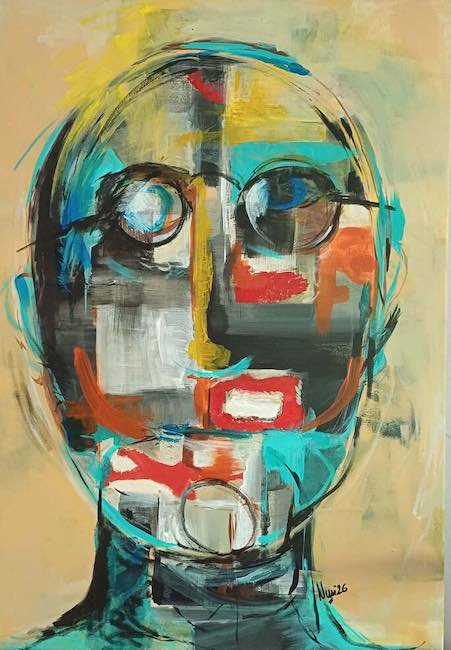
Questi autori erano contraddistinti da linee nette e fortemente marcate, da colori pieni e assolutamente decontestualizzati rispetto ai paesaggi e alle scene descritte, perché a predominare erano le emozioni di paura, rabbia, critica sagace verso un mondo nel pieno dei grandi conflitti e che dunque provocava perdita di certezze e timore nel futuro, nelle persone come negli artisti. Ma gli stessi sentimenti furono manifestati anche in maniera diversa, più concentrata sull’individualismo e sulla ricerca di una via d’uscita dalla cupezza provata, caratteristica questa che fu predominante nelle opere dell’austriaco Egon Schiele, il quale enfatizzò la sessualità come mezzo per esorcizzare la morte e come unica certezza in una destabilizzazione esterna che diversamente avrebbe portato alla pazzia. In Italia invece la figurazione in quei primi anni del Novecento, era più pacata e subiva le influenze dei movimenti più avanguardisti come il Cubismo, in particolar modo nella produzione pittorica di un simbolo sfuggente alle classificazioni stilistiche che risponde al nome di Amedeo Modigliani, la cui malinconia lirica e i volti eterei con i colli lunghi sono riconducibili a quel Primitivismo che tanto aveva caratterizzato i primi anni pittorici di Pablo Picasso. L’artista ungherese Monika Nun si collega esattamente al percorso di Modigliani, poiché le sue opere mostrano influenze espressioniste nell’attitudine a contornare i personaggi e i panorami con linee sottili e delicate come riscontrabile nei lavori di Egon Schiele, così come le tonalità sono decise e poco sfumate ma quasi fiabesche come nella poetica narrativa di Marc Chagall, e infine i volti simili a maschere africane e i colli lunghi non possono non essere ricondotti alle figure eteree di Amedeo Modigliani.
Solo che per Monika Nun è diversa la sostanza espressiva poiché in lei a emergere è il ricordo, il sogno fanciullesco di evadere da un’educazione rigida e poco comprensiva della personalità delicata di un bambino, così come l’approfondimento di una natura femminile che può realizzarsi solo nel momento in cui è in grado di esprimere tutte le sue sfaccettature, tutte quelle considerazioni che solo attraverso un consapevole dialogo interiore possono affiorare e prendere coscienza di sé. Si potrebbe dire che l’Espressionismo dell’autrice abbia delle forti componenti simboliste poiché utilizza il mondo animale o metafore per nascondere pulsioni e pensieri che se fossero descritti in altro modo apparirebbero troppo espliciti e comunque non affini alla sua sensibile e delicata personalità narrativa.
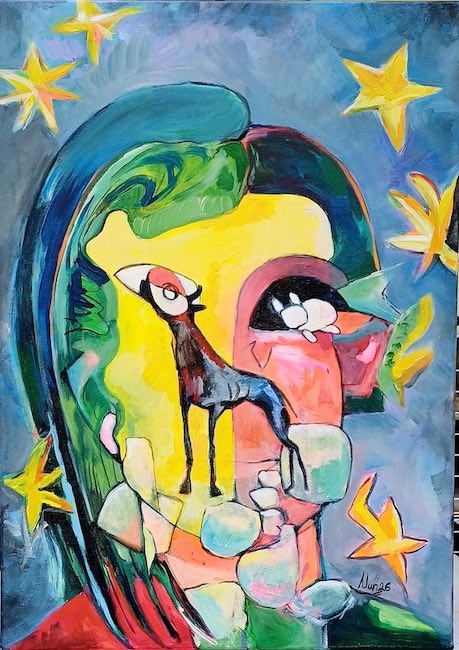
Ma ciò che colpisce è la sua esigenza di rinunciare ai dettagli dei visi per estenderli a una condizione condivisa, appartenente a lei e al suo vissuto così come a quello di una società contemporanea che tende spesso a silenziare il singolo nel nome di un’appartenenza quasi obbligata a un gruppo, a un insieme che può essere più facilmente guidato ed eterodiretto. Nelle tele di Monika Nun però a incidere in maniera più preponderante rispetto a qualsiasi dettaglio fisico, sono le caratteristiche interiori, i pensieri, le considerazioni, i sogni descritti in maniera lieve e accennata eppure fortemente presenti e in grado di fuoriuscire da una raffigurazione semplice che ricorda l’immediatezza espressiva dell’infanzia.
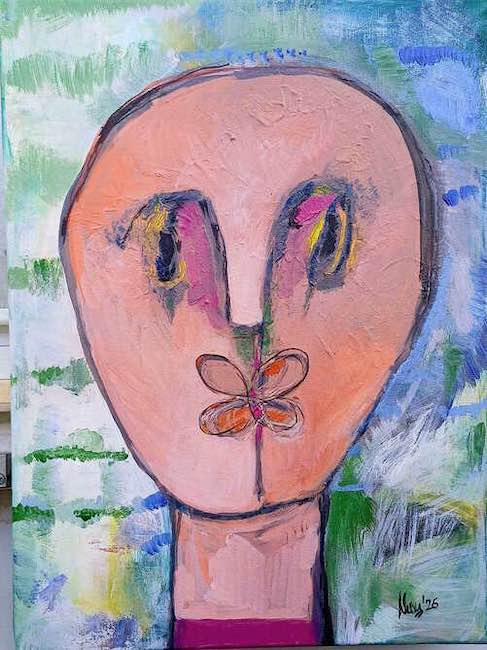
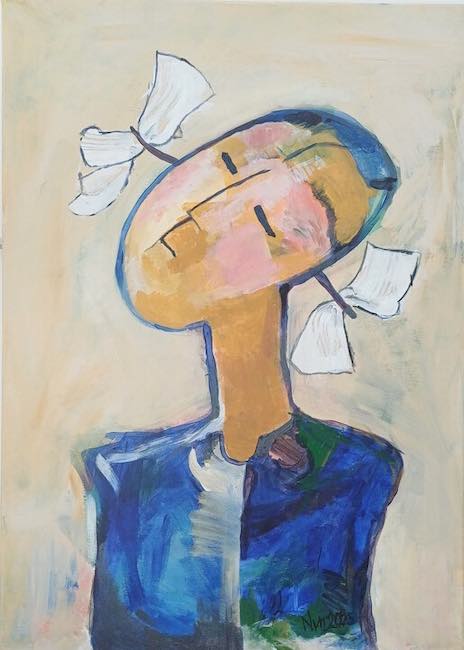
Il dipinto Little Girl with a Butterfly Pacifier è un esempio del concetto appena espresso poiché l’essenzialità stilizzata del tratto con cui l’autrice descrive la bambina cela un concetto più profondo e fortemente sentito dall’autrice che ripercorre, trasportandola in una dimensione onirica, la sensazione vissuta nella sua infanzia di non essere ascoltata davvero dagli adulti perché sempre zittita con carineria inducendola a credere che la sua voce non fosse importante. Il ciuccio a forma di farfalla rappresenta dunque quella gentilezza paternalistica con cui le persone si rivolgono ai bambini dimenticando di vederli come esseri umani che, malgrado la giovane età, possono essere in grado di pensare e di dire qualcosa di importante proprio perché non hanno ancora perduto la naturalezza e la spontaneità che, nella crescita, viene mediata dalla ragione e dalle convenzioni. Gli occhi alienati della ragazzina esprimono dunque il disagio di non aver potuto esprimere il proprio pensiero o la propria idea.
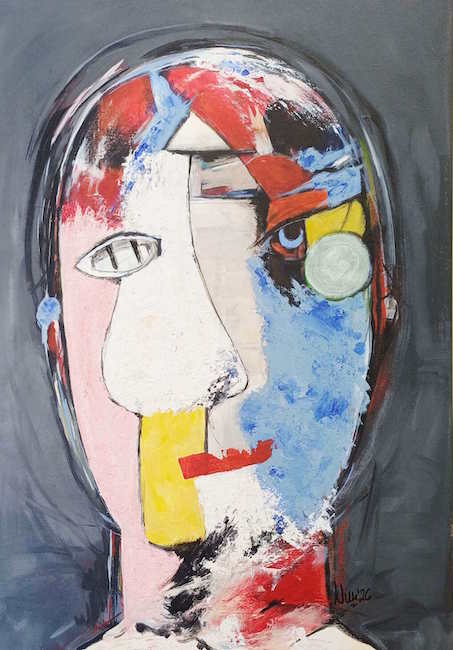
The Boat Eyed Girl affronta invece la problematica femminile che convince le donne ad aver bisogno di qualcuno che le salvi, di una scialuppa, inserita nel dipinto al posto dell’occhio sinistro del volto della ragazza, o di allontanarsi dalla sofferenza e dal disagio; in realtà, suggerisce Monika Nun, la forza per superare la sensazione di andare alla deriva è all’interno dell’anima stessa di ciascuna, perché non si potrà mai fuggire dalle proprie insicurezze, dai propri fallimenti e dai propri limiti finché non si comprende che solo attraverso un percorso di consapevolezza si possono superare trovando l’approdo più sicuro, quello dell’evoluzione di sé. Il lato destro del dipinto appare pertanto più equilibrato, come se una luce attraversasse le paure e i timori di non farcela per suggerire alla giovane che la forza è in lei, che può ottenere tutto ciò che vuole solo convincendosi di essere in grado di ottenerlo, così come la salvezza che tanto desidera può essere trovata scegliendo di avere più coraggio e cambiando ciò che va cambiato. In alcune opere invece, l’autrice si sofferma sulle tematiche più contemporanee, quelle che non può fare a meno di osservare intorno a sé e di analizzare da un punto di vista personale, che in fondo appartiene alla coscienza dell’essere umano sebbene la maggior parte delle persone vi si adegui quasi fosse impossibile ribellarsi o rinunciare a determinate dinamiche.
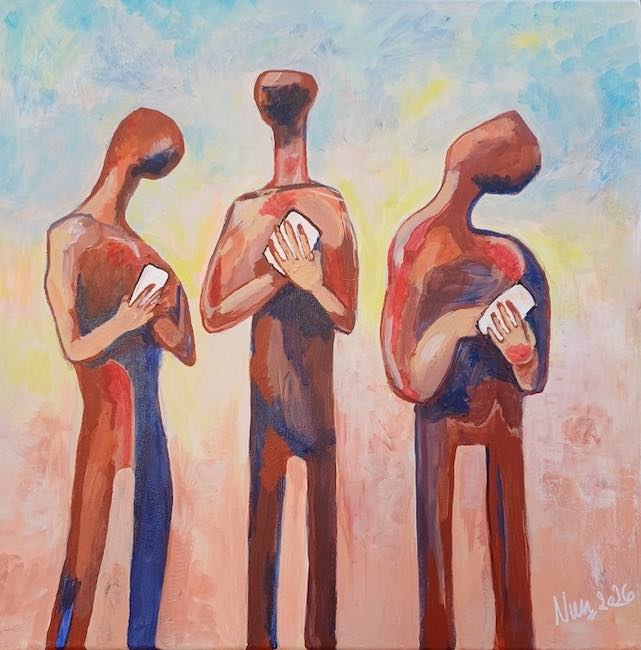
Una tra queste tele è Glued to Their Screen e raffigura la dipendenza dalla tecnologia, nel caso specifico dagli smartphone che sembrano aver fatto dimenticare quanto è bella la realtà intorno, impedendo agli individui di assaporare il momento preferendo fotografarlo o filmarlo per condividerlo sui social media perché altrimenti sente quasi di non essere stato presente senza quella testimonianza. Eppure l’essere umano ha vissuto per secoli senza questa iperconnessione, perché negli ultimi decenni ha perso così facilmente la sua vera essenza? Sembra domandare Monika Nun stimolando la riflessione dell’osservatore.
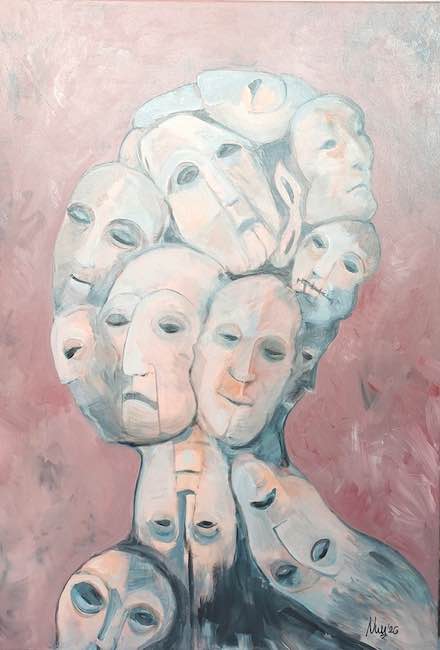
Questo lavoro si collega in maniera simbolica all’altra tela più esistenzialista, Identity 2 dove il volto in primo piano è composto di tanti altri piccoli volti, richiamando il tema delle maschere di Luigi Pirandello in cui l’individuo sopprime la propria vera identità per compiacere o adeguarsi a situazioni esterne che diversamente teme lo farebbero sentire escluso o ferito o non accettato. Ma la riflessione si estende anche al concetto di digitalità in cui chiunque può fingere di essere diverso da ciò che è in realtà perché filtrato dallo schermo di un computer o di un cellulare, falsando attraverso un rapporto virtuale l’esigenza umana di conoscersi davvero guardandosi negli occhi e mettendosi a nudo.
Monika Nun, artista e graphic designer con sede a Budapest, ha al suo attivo la partecipazione a mostre collettive e personali in Ungheria, in Canada, in Italia, in Austria, in Repubblica Ceca, è inserita tra gli artisti di Singulart, è membro diverse Associazioni artistiche della sua città tra cui The Artist Chamber.
MONIKA NUN-CONTATTI
Email: nun.monika@gmail.com
Sito web: www.monikanun.com/
Facebook: www.facebook.com/nun.monika
Instagram: www.instagram.com/monikanunart/
Childhood memories, dreamlike interpretations and feminine identity in Monika Nun’s Expressionism
Every artist’s creative journey draws primarily on personal experience and an emotionality that has found no other way to express itself except through a figurative gesture in which rationality is set aside to make way for that entire inner world that needs to break free in order to make its voice heard. In-depth exploration thus becomes essential for defining a style that aligns with the desired form of expression, just as the narrative language can be directed toward absolute clarity, toward a more cryptic and whispered image, or even toward an informal dissolution in which color alone becomes the means of emotional understanding. Today’s protagonist artist favors a stylistic approach in which the figurative element shifts toward the imaginary and merges with a chromatic intensity that highlights the significance of the emotional and dreamlike world through which she allows her inner self to speak.
In the very last years of the Nineteenth century emerged a need in the European art world to focus creative attention on that entire subjective universe that had previously been excluded due to the emphasis on aesthetics and faithful reproduction of reality that had predominated in all earlier forms of expression; it was precisely during that period, but especially at the dawn of the 20th century, that took shape a style in which beauty and harmony were relegated to the background in the light of the urgency to give free rein to the most spontaneous and intense emotions. This trend was initially known as Fauvism, named after the French artists who developed its theories, and later evolved into Expressionism once those expressive ideas became a full-fledged movement that swept across all of Europe. What was strikingly evident was the interpretive freedom each artist could exercise, precisely because the dialogue between the artist and the canvas was personal and intimate, for it was the voice of the artist’s inner self that spoke. Thus, the intense and almost aggressive hues of the Fauves such as Henri Matisse, who unleashed all the pulsating sensations he experienced by depicting glimpses of the everyday life he lived and amplified them through bold colors to emphasize their significance, were juxtaposed with the gloomy, leaden atmospheres of Northern European artists like Edvard Munch and Emil Nolde, as well as the sarcastic and critical narratives exposing the hypocrisy of the upper middle class, as depicted by the Austrian Oskar Kokoschka and the German Ernst Ludwig Kirchner.
These artists were characterized by sharp, strongly defined lines and rich, solid colors that were completely decontextualized from the landscapes and scenes they depicted, because what predominated were emotions of fear, anger, and incisive criticism of a world in the throes of major conflicts that thus instilled a loss of certainty and fear of the future in both the general public and the artists themselves. But these same feelings were also expressed in a different way more focused on individualism and the search for a way out of the gloom they felt, a characteristic that was caracteristic of the artworks of the Austrian artist Egon Schiele, who focused on sexuality as a means of exorcising death and as the sole certainty amid an external destabilization that would otherwise have led to madness. In Italy, on the other hand, figurative art in those early years of the 20th century was more subdued and was influenced by more avant-garde movements such as Cubism, particularly in the paintings of an artist who defies stylistic classification, Amedeo Modigliani whose lyrical melancholy and ethereal faces with long necks can be traced back to that Primitivism which had so strongly characterized Pablo Picasso’s early years as a painter. The Hungarian artist Monika Nun follows precisely in Modigliani’s footsteps, as her works reveal Expressionist influences in her approach to outlining figures and landscapes with thin, delicate lines as seen in the works of Egon Schiele, while her color palette is bold and minimally nuanced yet almost fairy-tale-like, reminiscent of Marc Chagall’s poetic narrative, and finally the faces resembling African masks and the long necks cannot help but be traced back to the ethereal figures of Amedeo Modigliani. However for Monika Nun the expressive substance is different, for what emerges in her work is memory, the childlike dream of escaping a rigid upbringing that showed little understanding of a child’s delicate personality, as well as an exploration of a feminine nature that can only be realized when it is able to express all its facets, all those reflections that can only surface and become self-aware through a conscious inner dialogue.
One might say that the author’s Expressionism has strong Symbolist elements, as she uses the animal world or metaphors to conceal impulses and thoughts that, if described otherwise, would appear too explicit and, in any case, out of step with her sensitive and delicate narrative personality. But what is striking is her need to forgo face details in order to extend them to a shared condition that belongs to her and her lived experience as much as it does to that of a contemporary society that often tends to silence the individual in the name of an almost compulsory belonging to a group, to a collective that can be more easily guided and controlled by others. In Monika Nun’s paintings, however, what carries greater weight than any physical detail are the inner qualities, the thoughts, reflections, and dreams depicted in a light and subtle manner, yet strongly present and capable of transcending a simple representation that evokes the expressive immediacy of childhood. The painting Little Girl with a Butterfly Pacifier serves as an example of the concept just described because the stylized, minimalist lines used to depict the girl conceal a deeper, intensely felt idea of the artist who revisits, transposing it into a dreamlike dimension, a childhood experience of not truly being heard by adults, who would instead silence her with an air of feigned sweetness, leading her to believe that her own voice did not matter.
The butterfly-shaped pacifier thus represents that paternalistic kindness with which people treat children, forgetting to see them as human beings who, despite their young age, may be capable of thinking and saying something important precisely because they have not yet lost the naturalness and spontaneity that, as they grow up, are tempered by reason and social conventions. The little girl’s alienated eyes thus express the distress of not having been able to express her own thoughts or ideas. Boat Eyed Girl on the other hand addresses the feminine dilemma that convinces women they need someone to save them, a lifeboat inserted into the painting in place of the left eye of the girl’s face, or to distance themselves from suffering and distress; in reality, Monika Nun suggests, the strength to overcome the feeling of drifting lies within each person’s very soul, because one can never escape one’s own insecurities, failures, and limitations until one understands that only through a journey of self-awareness can these be overcome by finding the safest harbor, that of self-evolution. The right side of the painting therefore appears more balanced, as if a light were piercing through the fears and anxieties of failure to suggest to the young woman that her strength lies within her, that she can achieve anything she wants simply by convincing herself she is capable of doing so, just as the salvation she so desires can be found by choosing to be more courageous and changing what needs to be changed.
In some paintings, however, the artist focuses on more contemporary themes, those she cannot help but observe around her and analyze from a personal perspective, themes that ultimately belong to the human consciousness, even though most people conform to them as if it were impossible to rebel against or break free from certain dynamics. One such painting is Glued to Their Screen, which depicts addiction to technology, specifically to smartphones, which seem to have made people forget how beautiful the reality around them is, preventing individuals from savoring the moment and instead leading them to photograph or film it to share on social media, because otherwise they almost feel as though they weren’t truly present without that record. Yet human beings have lived for centuries without this hyperconnectivity, why have they so easily lost their true essence in recent decades? Monika Nun seems to ask, prompting the viewer to reflect.
This work is symbolically linked to another more existentialist painting, Identity 2, in which the face in the foreground is composed of many other small faces, evoking the theme of masks og Luigi Pirandello where the individual suppresses their true identity to please others or conform to external situations that they otherwise fear would make them feel excluded, hurt, or rejected. But the reflection also extends to the concept of digitality, in which anyone can pretend to be different from who they really are because they are filtered through a computer or cell phone screen, distorting, through a virtual relationship, the human need to truly know one another by looking into each other’s eyes and baring one’s soul. Monika Nun, an artist and graphic designer based in Budapest, has participated in group and solo exhibitions in Hungary, Canada, Italy, Austria, and the Czech Republic, she is listed among the artists on Singulart and is a member of several art associations in her city, including The Artist Chamber.