

Esistono pensieri e verità che non sempre possono essere gridati o espressi con chiarezza, vi sono a volte considerazioni, emozioni, riflessioni che devono essere sussurrate, filtrate attraverso il colore e poi manifestate delicatamente in maniera introspettiva, quasi appartenessero a un mondo interiore di cui la rappresentazione è solo una proiezione. Quando un artista ha questo tipo di approccio pittorico, la realtà viene spalmata e diffusa all’interno di una dimensione immaginativa e sognante, come se avesse bisogno di emanare la sua eco prima di concretizzarsi sulla tela sotto forma di visione, di immagine che riesce a risuonare nelle corde interne dell’osservatore, oltre che dell’autore. Dominic Chambers appartiene a questa tipologia di interpreti e dà vita a uno stile in cui a predominare su qualunque altro aspetto del dipinto sono il colore e le continue sovrapposizioni che sembrano evocare gli strati di realtà in cui egli stesso si trova, o si è trovato, a vivere.
Alla fine del Diciannovesimo secolo fu chiaro a molti artisti, così come a tutti gli appartenenti al mondo della cultura, quanto non potesse più essere possibile mantenere la manifestazione pittorica e scultorea legate puramente all’estetica, alla riproduzione di una forma esteriore ormai insufficiente a connettersi con la realtà sociale che stava emergendo in maniera via via più evidente e che richiedeva una maggiore attenzione all’interiorità e al sentire dell’essere umano. La disumanizzazione della Rivoluzione Industriale aveva spinto diversi autori a compiere una ricerca che considerasse il legame tra la natura, le sue energie, e l’individuo, mentre altri preferirono concentrarsi solo e unicamente su quel mondo emotivo troppo a lungo ignorato dall’arte accademica. Le due tendenze sfociarono nel Simbolismo, che osservò profondamente le energie sottili, l’interazione tra soprannaturale e uomo, e l’Espressionismo che invece scelse di dare prevalenza assoluta all’irrazionalità del sentire al punto di volersi distaccare da ogni parametro reale, estetico, cromatico fino a quel punto considerato come irrinunciabile.
Se da un lato i simbolisti come Odilon Redon si concentrarono sull’irreale nascosto al di sotto dell’illusione di un visibile accattivante e delicatamente affascinante come le sue scene naturali piene di fiori impalpabili, dall’altro quelli più estremi come Arnold Böcklin indugiarono e raccontarono l’inquietudine di un mondo al confine tra il qui e l’aldilà tratteggiandone le atmosfere sottili. Di contro invece i Fauves, precursori degli espressionisti, manifestarono con forza e aggressività, al punto di meritarsi l’appellativo di bestie, quella necessità impellente di connettersi profondamente con le loro sensazioni, con le emozioni che non potevano più prescindere dal fare arte poiché dovevano essere proprio quelle a contraddistinguere il loro innovativo stile. Nel caso dei Fauves prima e dell’Espressionismo poi, dove la rinuncia all’armonia estetica e alla fedeltà a quanto l’occhio poteva osservare nella realtà era un imperativo fondante dei due movimenti, il linguaggio narrativo era completamente affidato al colore che si accordava ai moti interiori dei vari interpreti. Laddove Henri Matisse e André Derain scelsero tonalità piene, passionali, intense, gli espressionisti tedeschi di Der Blaue Reiter si soffermarono invece sulle trasparenze, sul sogno, sulle sovrapposizioni di strati di realtà che infondevano un’atmosfera fiabesca alle opere di Franz Marc e a quelle di Paul Klee. Nell’ambito del Simbolismo invece, la necessità di mantenere una figurazione più vicina al reale, seppur ammantata di quell’alone soprannaturale collegabile, in base al singolo interprete, alla magia che pervade la realtà, la poesia delle sensazioni e l’interazione tra interno dell’individuo e ambiente circostante che emana e riceve energie adeguandosi, si traduceva nello stile unico e impalpabile di uno dei maggiori rappresentanti del movimento, Gustav Klimt, il cui stile era legato anche all’Art Nouveau. L’artista afroamericano Dominic Chambers fonde le esperienze pittoriche del Simbolismo con le caratteristiche essenziali dell’Espressionismo per raccontare il proprio punto di vista sulla realtà, sulle ingiustizie razziali contro cui il suo popolo ha sempre dovuto combattere, su quelle piccole abitudini domestiche e familiari che hanno il potere di ricaricare l’interiorità dell’essere umano.
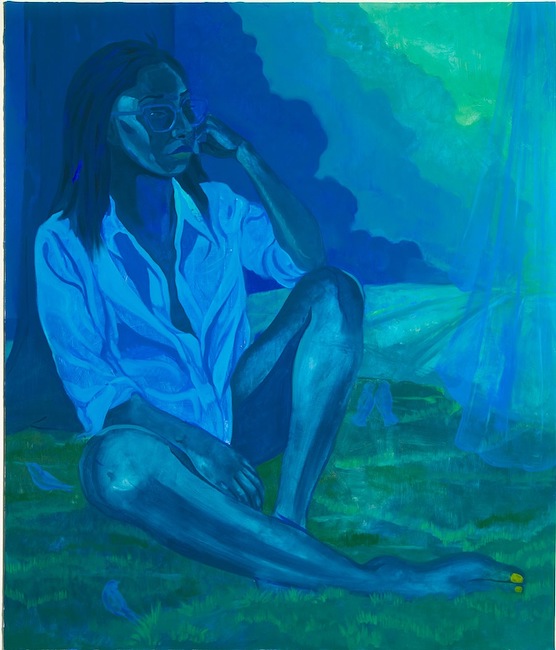
Da un lato dunque la presenza delle persone di colore di cui racconta istanti di rilassamento, di svago, di gioco o semplicemente di spaccati quotidiani e di attese, dall’altro le sovrapposizioni cromatiche in virtù delle quali accosta e stempera colori in apparente opposizione posti come delle velature che offuscano la limpidezza delle immagini sottostanti, filtrano la nitidezza per attenuare la visualizzazione di un mondo, quello africano, fino a qualche tempo fa ancora lasciato ai margini della società, come non fosse degno di avere le stesse opportunità, la stessa ammirazione che suscita invece la popolazione bianca.
In qualche modo dunque Dominic Chambers ironizza proprio sul tema dell’invisibilità che per troppi anni la civiltà ha riservato alle persone della sua razza, come se non volesse vedere, o guardare, tutta quella normalità, quelle espressioni, quei sentimenti comuni a tutti gli esseri umani, a qualsiasi etnia appartengano.
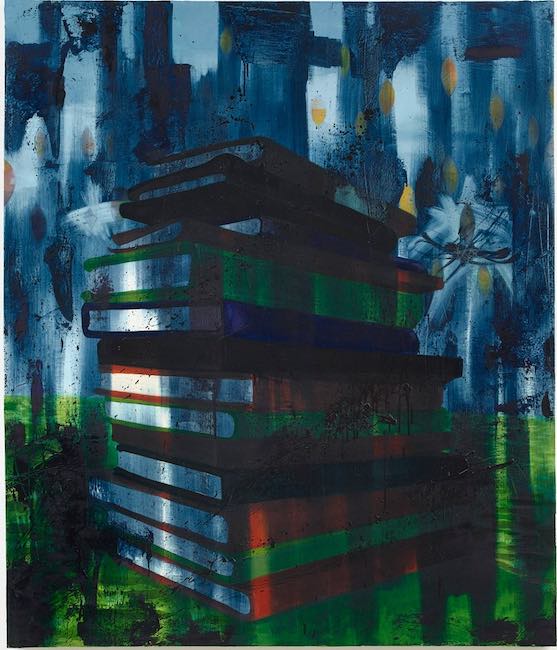
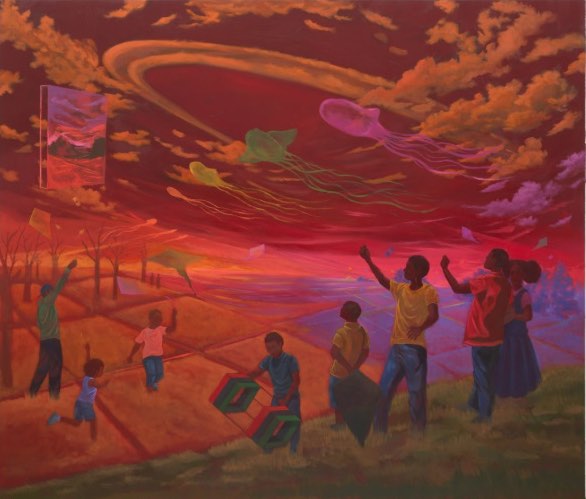
Dal punto di vista formale le sue opere sono un affascinante compromesso tra significato e forma, tra ciò che si nasconde tra le righe, o forse sarebbe meglio dire tra i veli di realtà, e ciò che invece emerge incontrastabile uscendo proprio in virtù di quelle dissolvenze, di quel volersi nascondere; i colori sono incredibilmente Fauves, intensi, e di dipinto in dipinto la narrazione viene affidata a tonalità predominanti come in Through the coming grass dove il rosso e il rosa si incontrano e si fondono per propagare su tutta la tela l’intimità e la piacevolezza provata dai due ragazzi nel gesto semplice di far volare degli aquiloni.
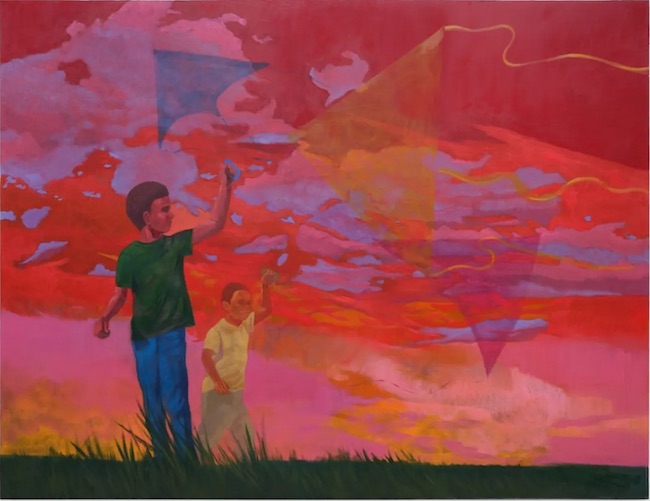
Eppure quei leggeri oggetti rappresentano allegoricamente la capacità di volare, di innalzarsi, si legano al senso di libertà divenendo pertanto simbolo di quel desiderio di affermazione che ciascun afroamericano prova da sempre, quasi la sua fosse una scommessa non solo con se stesso ma anche con un mondo esterno ancora troppo pieno di preconcetti e di ostacoli dettati da luoghi comuni inutili e limitanti. In quel gesto ingenuo i due bambini possono sognare e correre liberi da tutto, ecco il motivo per cui il cielo, pur essendo intriso di rosso, appare leggero, impalpabile, quasi volesse avvolgere l’emozionalità dei due protagonisti e guidarla verso nuove possibilità.
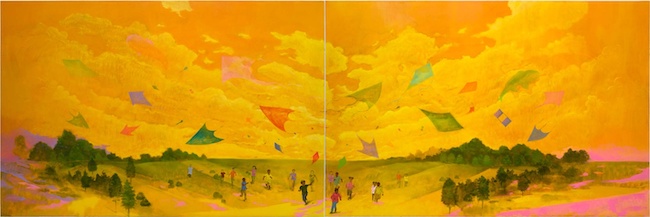
In When the laughters gathers invece la dominante gialla simboleggia la spensieratezza, la felicità e le risate, a cui si riferisce il titolo, dei fanciulli che possono vivere nella spontaneità perché immersi nella natura, in un mondo che non li giudica bensì li accoglie e sembra abbracciarli proprio per un’innocenza che si può manifestare liberamente attraverso il gioco. Gli alberi e le colline che circondano la vallata dove i piccoli stanno facendo volare i loro aquiloni sembrano costituire un bacino di protezione, una barriera che tutela quel momento gioioso, come se la natura volesse farlo rimanere così per sempre, salvaguardandoli dal contatto con una realtà esterna non sempre positiva e serena come quegli istanti. Eppure, oltre le coltri verde scuro, Dominic Chambers tratteggia uno scenario che vira verso il rosa, come a suggerire che il futuro può sorridere perché può presentare anche sorprese inaspettate, il futuro è anche speranza per quei bambini che forse potranno misurarsi solo e unicamente con le loro capacità, con le loro ambizioni senza che la razza e il colore della pelle possano costituire un ostacolo come fu in passato.
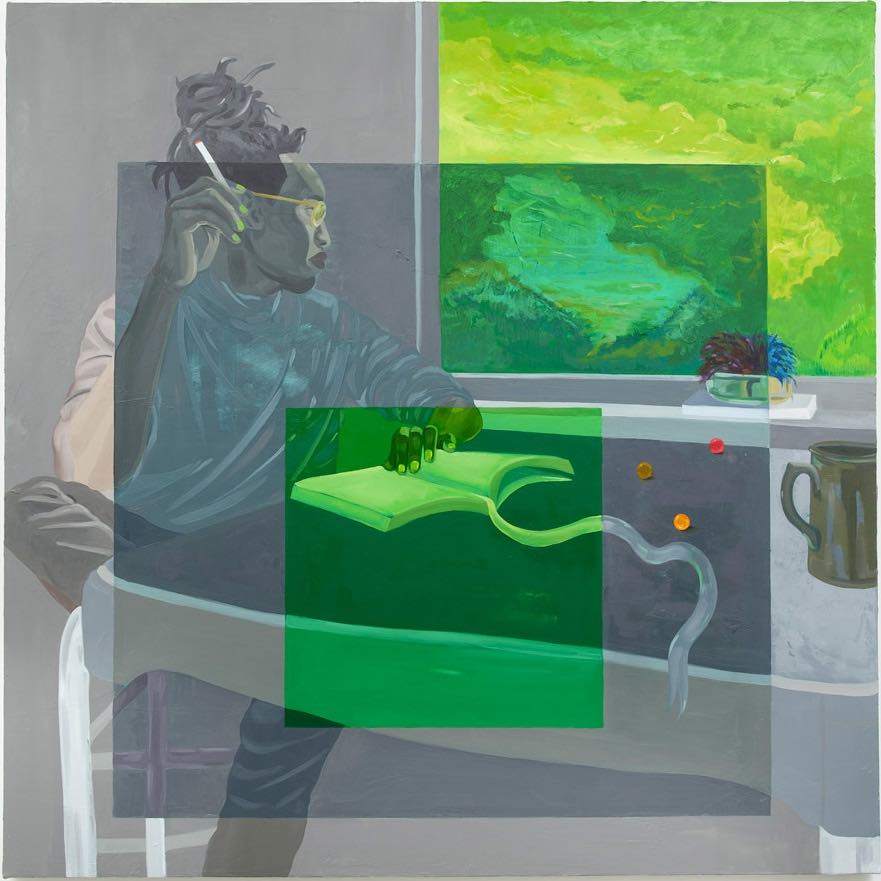
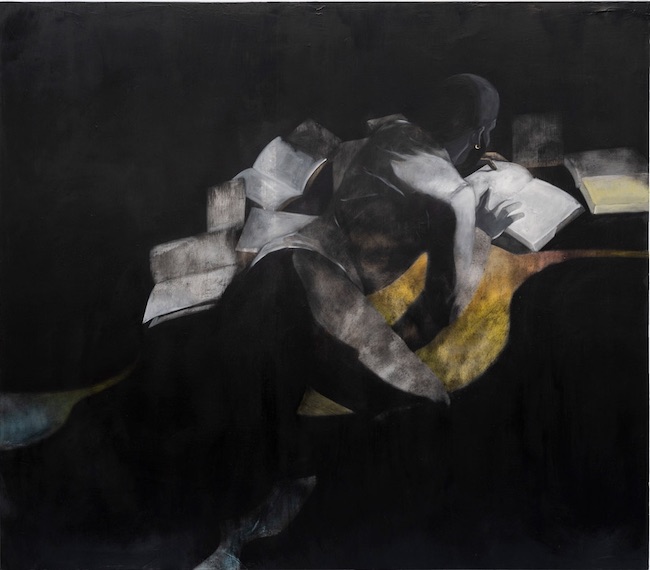
After Albers Africanus è forse l’opera più simbolista, dove le velature sono talmente presenti da essere predominanti sull’immagine sottostante e in virtù delle quali l’uomo protagonista della scena si trova al confine tra ricordo e visione, tra evocazione e presenza, quasi si stesse dissolvendo nelle pieghe del tempo. O del significato che Dominic Chambers attribuisce a quell’istante di rilassamento, di riflessione che si intuisce nella parte di dipinto in grigio, subito dopo interrotta da finestre di verde acceso che ne mettono in luce solo alcuni dettagli importanti per l’autore nel momento dell’esecuzione del dipinto. L’ambientazione esterna suggerisce un’immersione nella natura sospinta forse dalle pagine del libro che il protagonista sta leggendo, che infatti viene messo in evidenza attraverso un riquadro trasparente nella stessa tonalità dell’esterno, e i pensieri dell’uomo elaborano le parole scritte attraverso un sogno a occhi aperti in virtù del quale la realtà viene costruita dall’immaginazione.
Dominic Chambers ha al suo attivo mostre personali a St. Louis, Reston ( Virginia), New York, Pittsburgh, Torino, e Des Moines (Iowa) e collettive a Shanghai, Città del Capo, Miami, Dallas, Chicago, Palm Beach, Los Angeles, Seattle, Charlotte, Milwaukee, New Haven, New York, Milwaukee, Portland, Madison, Baltimora, Norfolk; le sue opere sono presenti in numerose collezioni private e pubbliche, tra cui il Centre Pompidou di Parigi, il Crocker Art Museum di Sacramento, la Green Family Art Foundation di Dallas, l’High Museum of Art di Atlanta, l’Hirshhorn Museum and Sculpture Garden di Washington, l’Institute of Contemporary Art, Miami, Long Museum di Shanghai, Los Angeles County Museum of Art (LACMA), Morehouse College di Atlanta, Museum of Fine Arts di Boston, Pérez Art Museum di Miami, Vanhaerents Art Collection di Bruxelles e lo Xiao Museum of Contemporary Art, Rizhao, Cina.
DOMINIC CHAMBERS-CONTATTI
Email: inquire@lehmannmaupin.com
Sito web: www.chambersstudio.com/
Facebook: www.facebook.com/dominic.phillips.14
Instagram: www.instagram.com/chambersdominic/
Veils and overlays in Dominic Chambers’ Symbolist Expressionism
There are thoughts and truths that cannot always be shouted out loud or expressed clearly, sometimes there are considerations, emotions, and reflections that must be whispered, filtered through color, and then delicately manifested in an introspective manner, as if they belonged to an inner world of which representation is only a projection. When an artist has this kind of pictorial approach, reality is spread and diffused within an imaginative and dreamlike dimension, as if it needed to emanate its echo before materializing on the canvas in the form of a vision, an image that resonates with the innermost feelings of the observer as well as the author. Dominic Chambers belongs to this type of interpreter and creates a style in which color and continuous overlays predominate over any other aspect of the painting, seeming to evoke the layers of reality in which he finds himself, or has found himself, living.
At the end of the 19th century, it became clear to many artists, as well as to all those belonging to the world of culture, that it was no longer possible to keep painting and sculpture purely linked to aesthetics, to the reproduction of an external form that was no longer sufficient to connect with the social reality that was emerging in an increasingly evident manner and that required greater attention to the inner life and feelings of human beings. The dehumanization of the Industrial Revolution had prompted several authors to undertake research that considered the link between nature, its energies, and the individual, while others preferred to focus solely on the emotional world that had been ignored for too long by academic art. The two trends led to Symbolism, which observed in depth subtle energies and the interaction between the supernatural and man, and Expressionism, which instead chose to give absolute prevalence to the irrationality of feeling to the point of wanting to detach itself from all real, aesthetic, and chromatic parameters that had been considered indispensable up to that point. While Symbolists such as Odilon Redon focused on the unreal hidden beneath the illusion of an appealing and delicately fascinating visible world, such as his natural scenes full of intangible flowers, the more extreme ones, such as Arnold Böcklin, lingered and recounted the unease of a world on the border between here and the afterlife, sketching its subtle atmospheres. On the other hand, the Fauves, precursors of the Expressionists, manifested with such force and aggression, to the point of earning themselves the nickname “beasts,” that urgent need to connect deeply with their feelings, with emotions that could no longer be separated from their art, since it was precisely those emotions that distinguished their innovative style. In the case of the Fauves first and then Expressionism, where the renunciation of aesthetic harmony and fidelity to what the eye could observe in reality was a fundamental imperative of the two movements, the narrative language was completely entrusted to color, which was in tune with the inner motions of the various interpreters.
Where Henri Matisse and André Derain chose full, passionate, intense tones, the German Expressionists of Der Blaue Reiter focused instead on transparencies, dreams, and overlapping layers of reality that infused the artworks of Franz Marc and Paul Klee with a fairy-tale atmosphere. In Symbolism, on the other hand, the need to maintain a figuration closer to reality, albeit cloaked in that supernatural aura linked, according to the individual artist, to the magic that pervades reality, the poetry of sensations and the interaction between the individual’s inner world and the surrounding environment which emanates and receives energy by adapting itself, was translated into the unique and intangible style of one of the movement’s leading representatives, Gustav Klimt, whose style was also linked to Art Nouveau. African-American artist Dominic Chambers blends the pictorial experiences of Symbolism with the essential characteristics of Expressionism to convey his point of view on reality, on the racial injustices his people have always had to fight against, on those small domestic and family habits that have the power to recharge the inner self of human beings. On the one hand, therefore, there is the presence of black people, whose moments of relaxation, leisure, play, or simply everyday life and waiting he depicts, on the other, there are the chromatic overlays by which he combines and softens seemingly opposing colors, placed like veils that blur the clarity of the images below, filtering the sharpness to attenuate the visualization of a world, the African one, which until recently was still left on the margins of society, as if it were not worthy of having the same opportunities and the same admiration that the white population arouses.
In some ways, therefore, Dominic Chambers ironically addresses the theme of invisibility that civilization has reserved for people of his race for too many years, as if it did not want to see, or look at, all that normality, those expressions, those feelings common to all human beings, whatever ethnicity they belong to. From a formal point of view, his artworks are a fascinating compromise between meaning and form, between what is hidden under the lines, or perhaps it would be better to say below the veils of reality, and what instead emerges unchallenged precisely because of those fades, that desire to hide; the colors are incredibly Fauves, intense, and from painting to painting, the narrative is entrusted to predominant tones, as in Through the Coming Grass where red and pink meet and blend to spread across the canvas the intimacy and pleasure felt by the two boys in the simple act of flying kites. Yet those light objects allegorically represent the ability to fly, to rise, and are linked to the sense of freedom, thus becoming a symbol of that desire for affirmation that every African American has always felt, as if it were a bet not only with themselves but also with an outside world still too full of preconceptions and obstacles dictated by useless and limiting clichés. In that innocent gesture, the two children can dream and run free from everything, which is why the sky, despite being drenched in red, appears light, intangible, as if it wanted to envelop the emotions of the two protagonists and guide them towards new possibilities.
In When the Laughter Gathers, on the other hand, the dominant yellow symbolizes the carefree nature, happiness, and laughter referred to in the title, of children who can live spontaneously because they are immersed in nature, in a world that does not judge them but welcomes and seems to embrace them precisely because of an innocence that can be freely expressed through play. The trees and hills surrounding the valley where the children are flying their kites seem to form a protective basin, a barrier that shields that joyful moment, as if nature wanted it to remain that way forever, safeguarding them from contact with an external reality that is not always as positive and serene as those moments. Yet, beyond the dark green blankets, Dominic Chambers sketches a scenario that veers towards pink, as if to suggest that the future can smile because it can also present unexpected surprises, the future also holds hope for those children who may be able to measure themselves solely on their abilities and ambitions, without race and skin color being an obstacle as they were in the past.
After Albers Africanus is perhaps the most symbolist painting, where the glazes are so present that they predominate over the underlying image and, as a result, the man at the center of the scene finds himself on the border between memory and vision, between evocation and presence, as if he were dissolving into the folds of time. Or of the meaning that Dominic Chambers attributes to that moment of relaxation, of reflection, which can be sensed in the gray part of the painting, immediately interrupted by bright green windows that highlight only a few details important to the author at the time of the painting’s execution. The outdoor setting suggests an immersion in nature, perhaps inspired by the pages of the book the protagonist is reading, which is highlighted by a transparent frame in the same shade as the exterior, and the man’s thoughts elaborate on the written words through a daydream in which reality is constructed by the imagination.
Dominic Chambers has had solo exhibitions in St. Louis, Reston (Virginia), New York, Pittsburgh, Turin, and Des Moines (Iowa), and group exhibitions in Shanghai, Cape Town, Miami, Dallas, Chicago, Palm Beach, Los Angeles, Seattle, Charlotte, Milwaukee, New Haven, New York, Milwaukee, Portland, Madison, Baltimore, and Norfolk; his works are included in numerous private and public collections, including the Centre Pompidou in Paris, the Crocker Art Museum in Sacramento, the Green Family Art Foundation in Dallas, the High Museum of Art in Atlanta, the Hirshhorn Museum and Sculpture Garden in Washington, the Institute of Contemporary Art in Miami, the Long Museum in Shanghai, the Los Angeles County Museum of Art (LACMA), Morehouse College in Atlanta, the Museum of Fine Arts in Boston, the Pérez Art Museum in Miami, the Vanhaerents Art Collection in Brussels, and the Xiao Museum of Contemporary Art in Rizhao, China.